Home · History
A story of stones and people
From the Haut-Castel farm to Domaine de Tayssou: notarial deeds, old maps, photographs and rediscovered portraits.
Foreword
When we discovered this ruined farm in 2020, hidden in the woods just down the road from our home, its former owners mentioned a detail: the house may once have belonged to the Lauzerte hospice. That detail launched an investigation lasting several years, in the archives of Tarn-et-Garonne and Haute-Garonne, with the Amis de Lauzerte society and local historians Patrice Brassier and Jean-Claude Martinez, then from Versailles to New York and from London to Wales.
At Tayssou, history can be read in the layout of the buildings as much as in the deeds. The sources do not light every period equally, so we flag what the documents establish and what remains a hypothesis.
At heart, Tayssou is no château: it is a Quercy farm like hundreds of others in the region, a farmhouse of pale stone, a barn, a dovecote, a yard. What makes it rare is that it has kept a record of its whole life. Very few Quercy farms can follow, deed by deed, their owners, their sharecroppers, their harvests and even their repairs over more than three centuries. Its story is the ordinary, precious story of the Quercy countryside.
- Tayssou
- The place name probably comes from the Occitan tais or taisson, the badger: a wooded hillside where the animal had its setts.
- Former names
- The Daucastel farm (1711), “Aucastel” on the Cassini map, the Haut-Castel farm at the hamlet of Tayssou (1908).
- The site
- A ledge where the slope breaks, between the oak wood and the lower fields, facing Lauzerte, near Saint-Amans-de-Pellagal. About 2 hectares today, including an oak wood.
- The buildings
- A farmhouse set into the slope, a two-storey barn, a dovecote and outbuildings. Limestone and ochre sandstone, oak, lime.
- Aucastels
- The Haut-Castel motte, a few hundred metres away, a historic monument since 2022: the medieval castle that gave the farm its name.
The timeline
Eight centuries at a glance
Click a date to discover each episode, then dive into the full story below.
At the foot of Aucastels, a seigneurial site
A few hundred metres from the farm, on the spur above the Barguelonne valley, stands the Haut-Castel motte, listed as a historic monument on 7 March 2022. A motte-and-bailey (motte castrale) is an earthen mound, natural or man-made, crowned by a tower and ringed by a palisade, later a wall: the earliest form of the medieval castle, between the 10th and 13th centuries, around which land, tracks and people were organised.
Mentioned since the 10th century as Hautmont, Aucastels and then Haut-Castel, it was held by the Durfort family, then the Loubéjac and, from 1230, the Castagner. It keeps a brick tower from the late 12th or early 13th century. In 1614 an inheritance quarrel led to it being bombarded for three days; abandoned, it was replaced around 1760 by a new château on the neighbouring hill, the Cassini map shows both “Aucastels” and “Aucastels Neuf”.
The “Daucastel” farm, “of Aucastel”, takes its name from this lordship. It probably appeared at the turn of the Middle Ages and the early 16th century, when the Quercy countryside was resettled after the Hundred Years’ War: a ledge halfway up the hillside, near an old road, facing the village of Lauzerte as it spread along its spur. It is the typical setting of Quercy Blanc farms, between the low fields and the woods.
Haut-Castel motte, Saint-Amans-de-Pellagal · historic monument since 7 March 2022 (Mérimée PA82000050)
A medieval core
The farmhouse follows the logic of Quercy houses: a lower level of cellar and wine store set into the ground, and a living floor reached by an outside staircase. Its walls mix limestone and ochre sandstone; some openings and a round-arched bread oven suggest early forms. The 2021 architectural study places part of the core between the 13th and 15th centuries, a hypothesis based on form, not yet confirmed by dating the timbers or mortars. During the works several old coins came out of the ground, one of them struck around 1560; together with some reused stones, they bear witness to a very old heritage.
The Darnals, lawyers of Lauzerte
Why did the Darnals divide their lives between Toulouse and Lauzerte? We do not know: before the 16th century the archives fall silent. One thing is certain, the farm is older than they are, and the mystery remains.
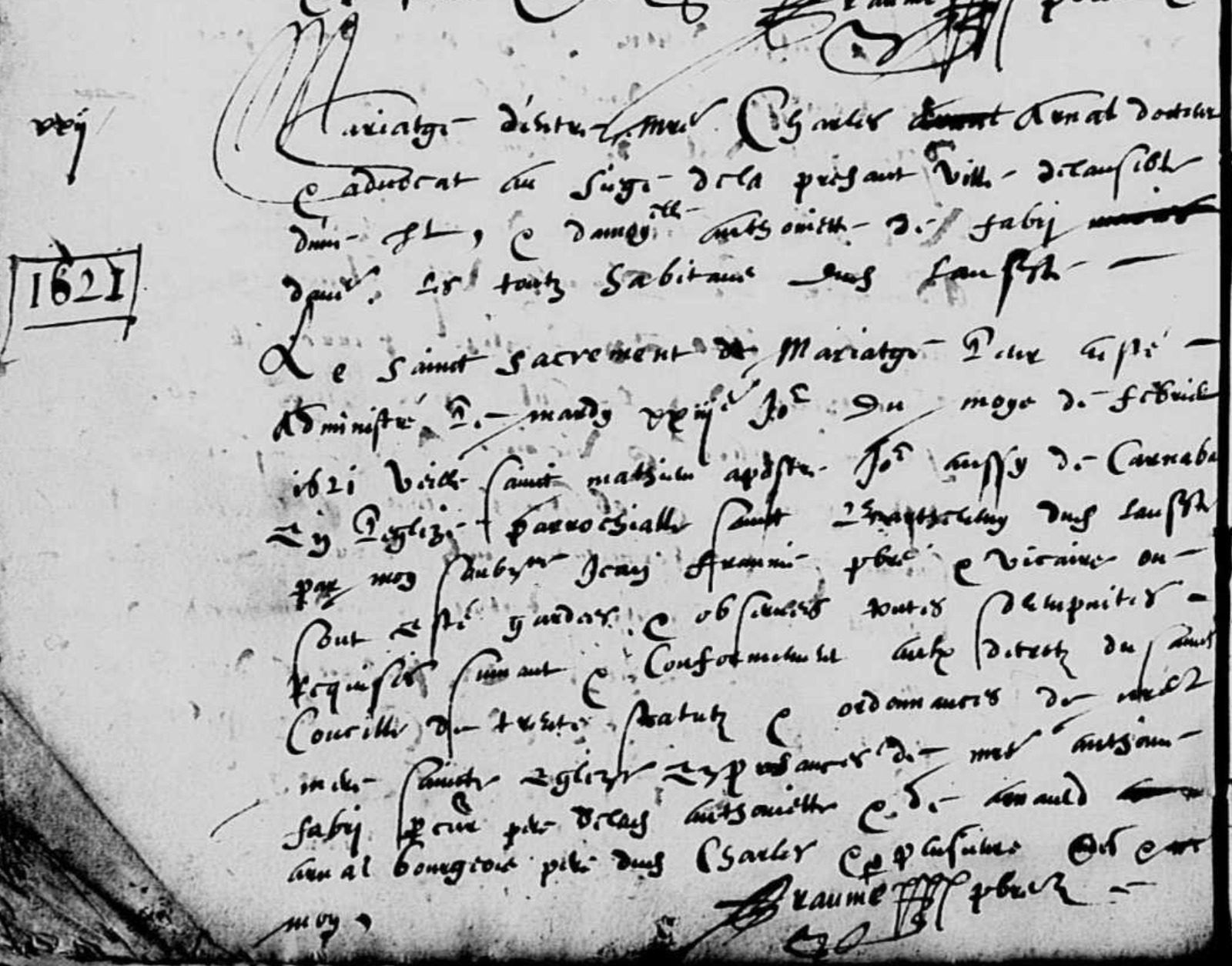
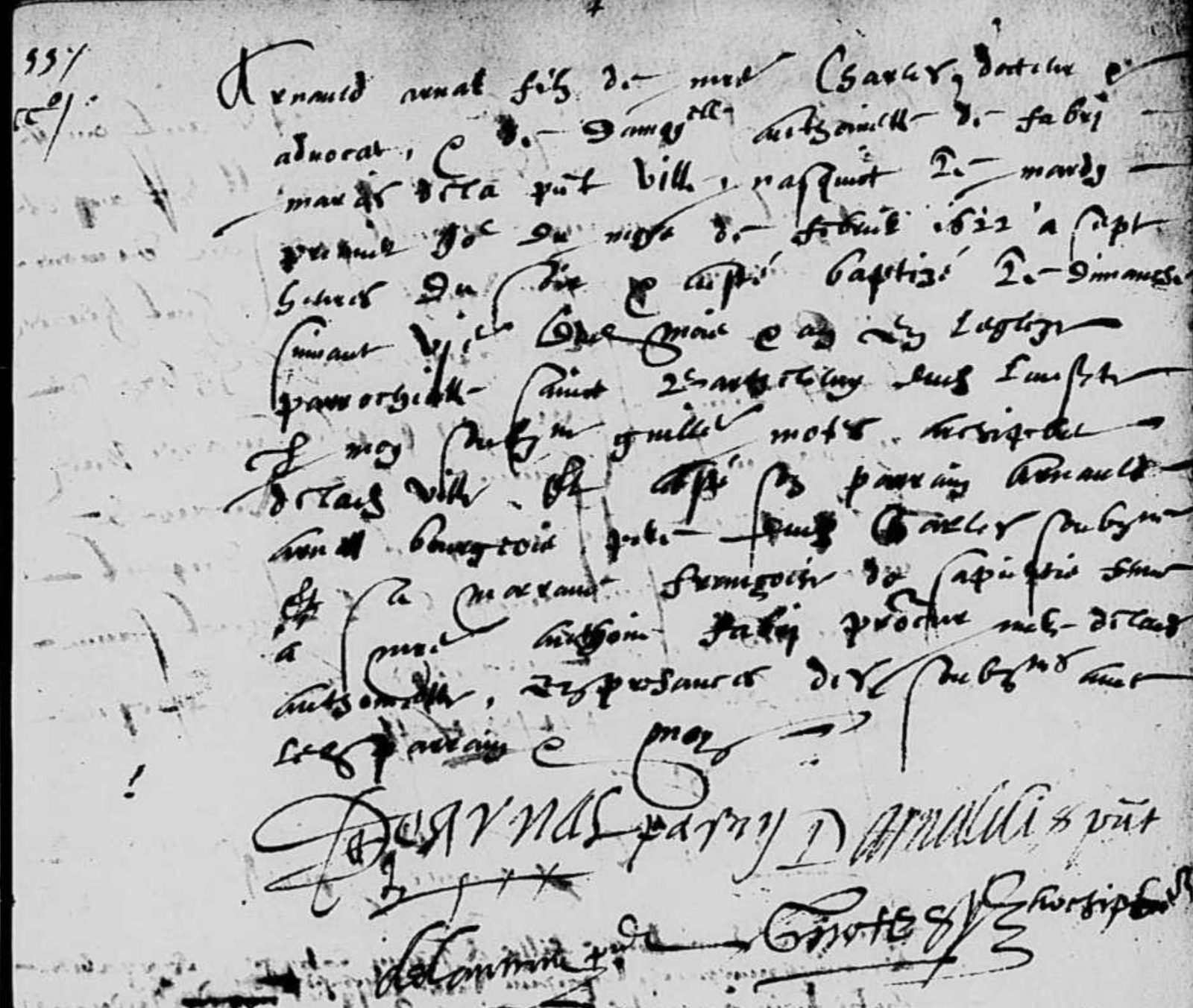
On 28 February 1621, in Lauzerte’s Saint-Barthélemy church, Charles Arnal, doctor of law and barrister, marries Antoinette Fabri, daughter of a local prosecutor. Their son Arnaud is born on 1 February 1622. He is very probably Fleur’s father: an Arnaud Darnal, doctor of law and barrister, marries Jacquette de La Bonne in 1649, and a Charles Darnal is Fleur’s godfather in 1660. The family signs sometimes Arnal, sometimes Darnal.
Marrying a capitoul’s daughter
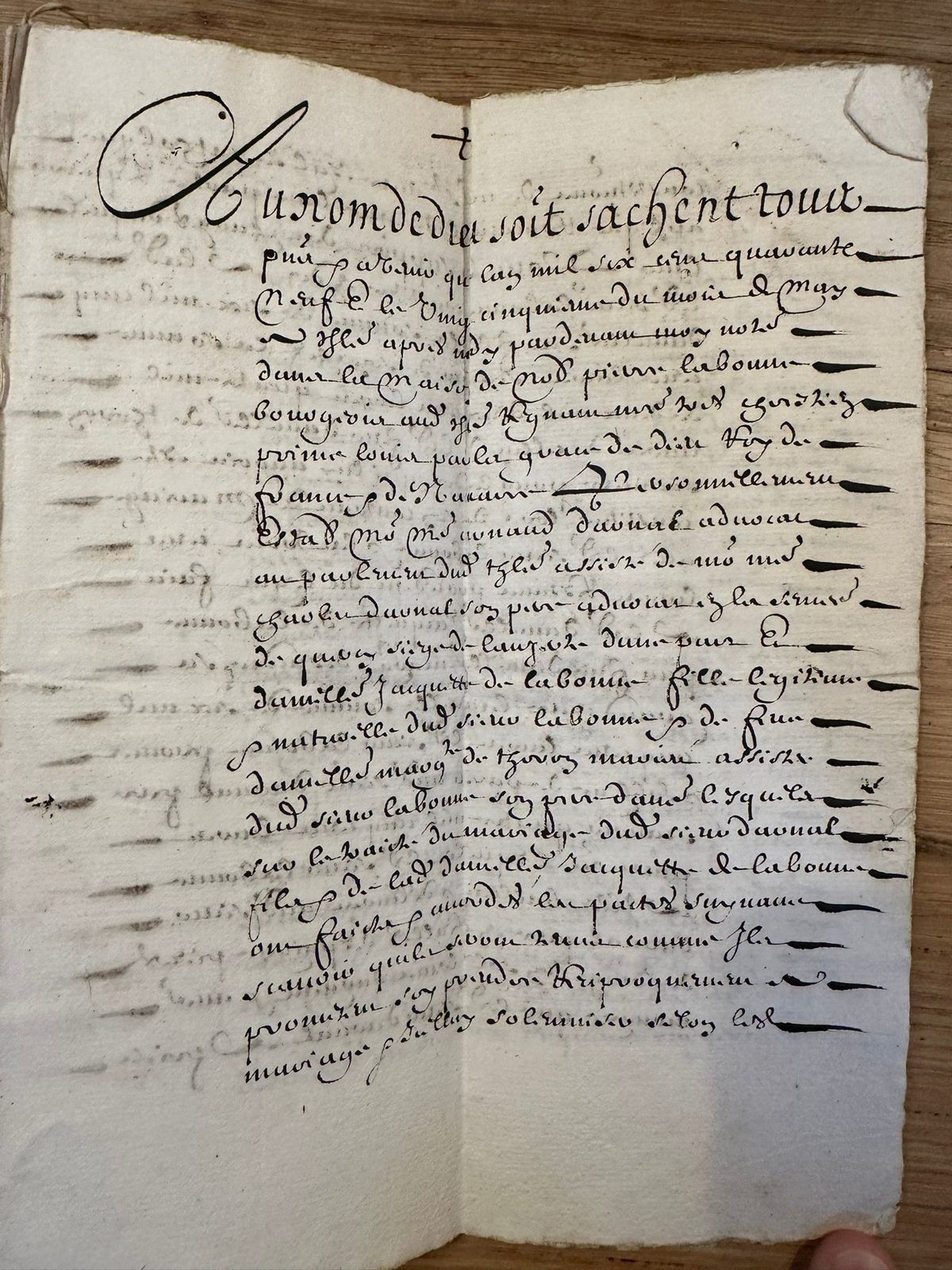
In Toulouse, in the house of the nobleman Pierre de La Bonne, the marriage contract of Arnaud Darnal, barrister, and Jacquette de La Bonne is signed. Pierre de La Bonne was a capitoul of Toulouse in 1635 and 1650, one of the highest municipal offices in the kingdom, which conferred nobility.
The La Bonne family lived in the heart of Toulouse, on rue des Changes, between the Capitole and La Daurade; their town house still stands. It was in this world of Toulouse lawyers and merchants that Jacquette, Fleur’s mother, grew up.
Pierre de La Bonne, capitoul of Toulouse
Every year the capitouls were painted in the city’s Annals, with their coats of arms. In the 1650 illumination, “Noble Pierre De La Bonne, bourgeois” bears a blue shield with a dove, the arms recorded in the armorial of the capitouls.

“Azure, a rock argent shaded sable, surmounted by a dove rising argent holding in its beak an olive branch Or, and a ray of the same issuing from the dexter chief.”
Heraldic reading by Liliane Gaubert. Interpretive drawing made for this website.
Fleur de Darnal is born
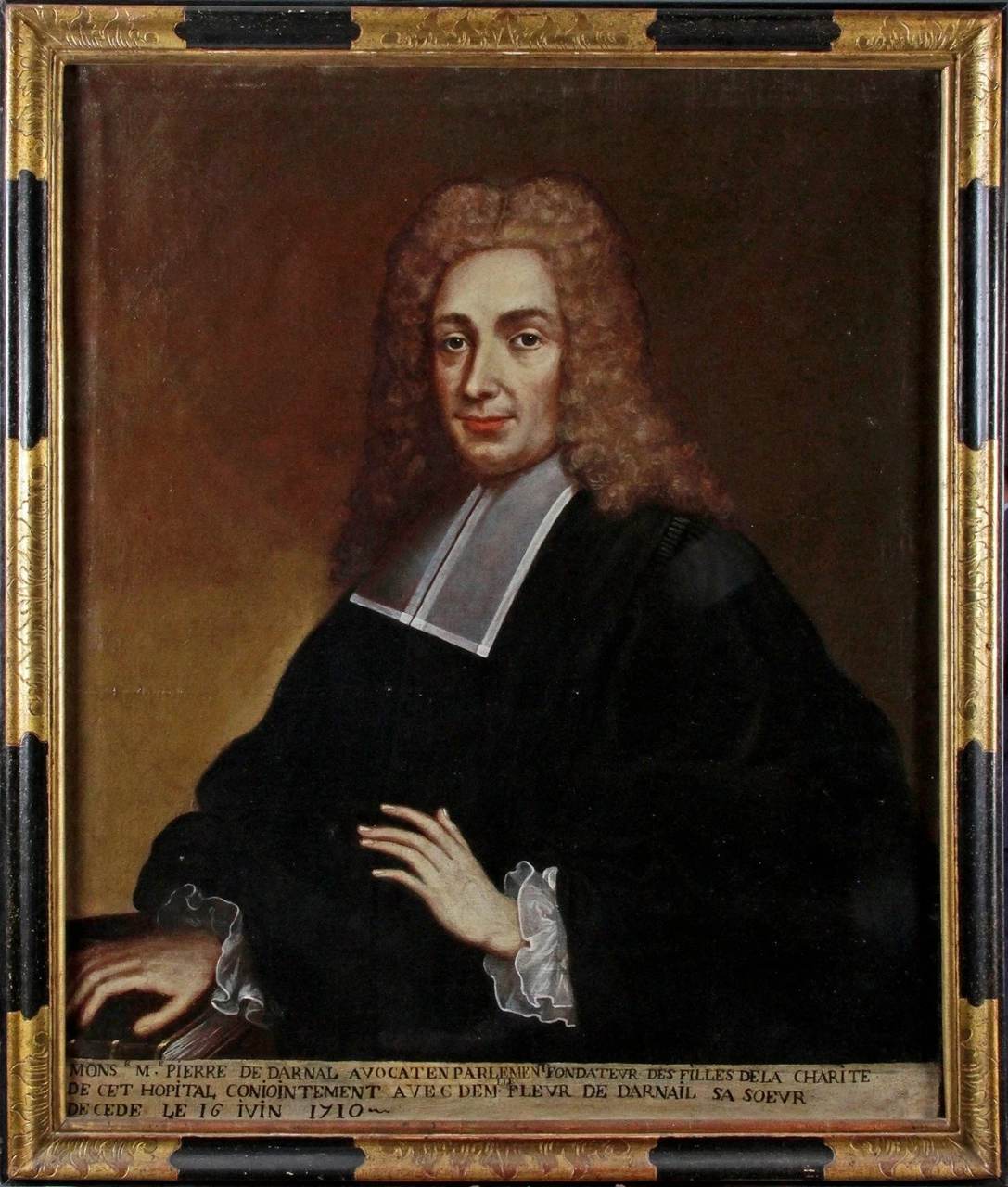
Fleur is born in Lauzerte on 21 June 1660 and baptised five days later. She is named after her godmother and aunt, Fleur de La Bonne (1642–1683). She has an elder sister, Germaine (1657), and a younger brother, Pierre (1663), who becomes a barrister at the parlement of Toulouse.
Brother and sister, founders of the Daughters of Charity
As heirs to the family fortune, Fleur and Pierre revive the declining Lauzerte hospital and found the Daughters of Charity there to nurse the sick. Pierre dies on 16 June 1710, as the inscription on his portrait recalls. His death very probably leaves Fleur sole heir to the family fortune, which explains why, the very next year, she arranges the handing-on of her property: the gift of 8 September 1711.
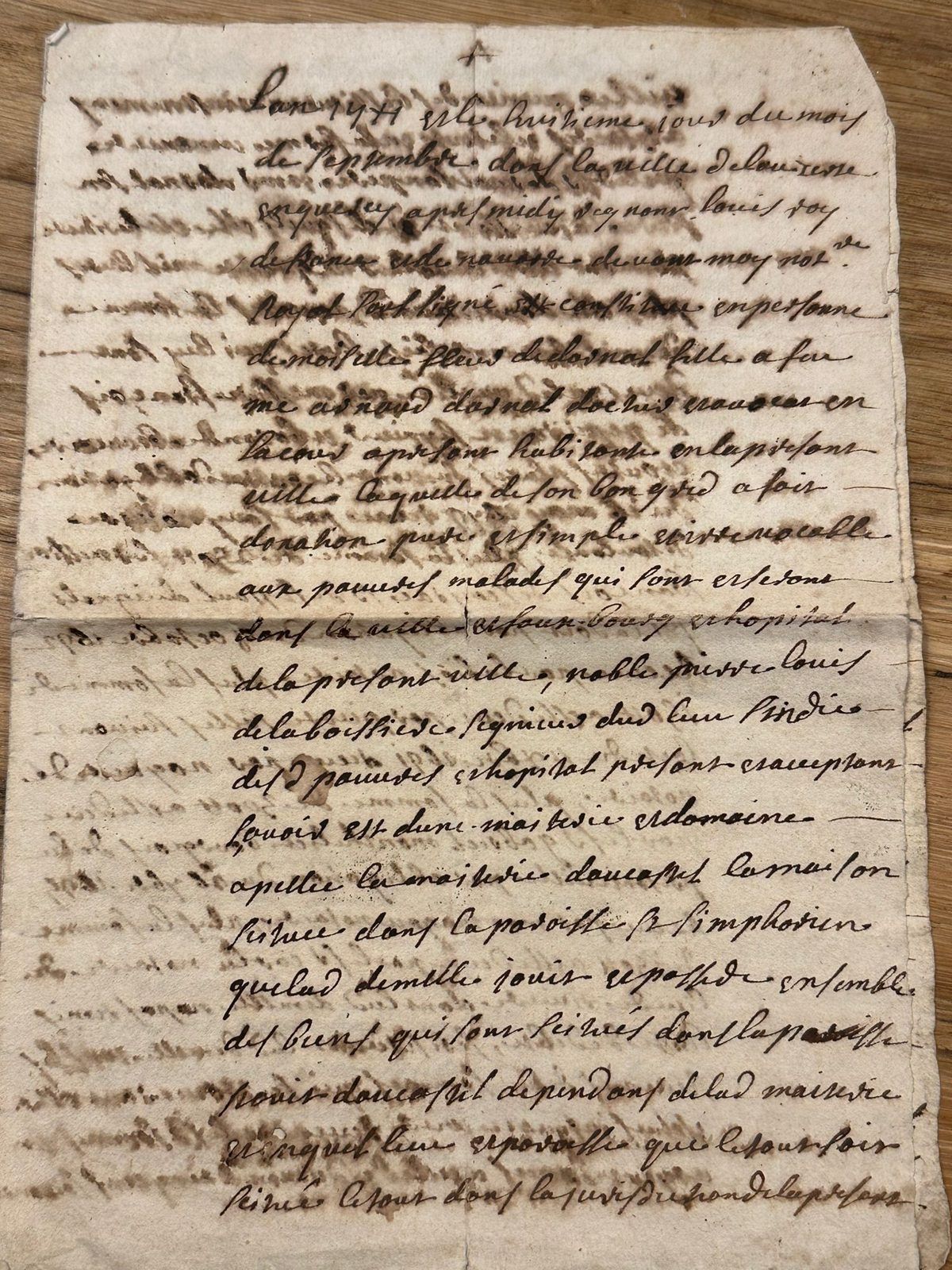
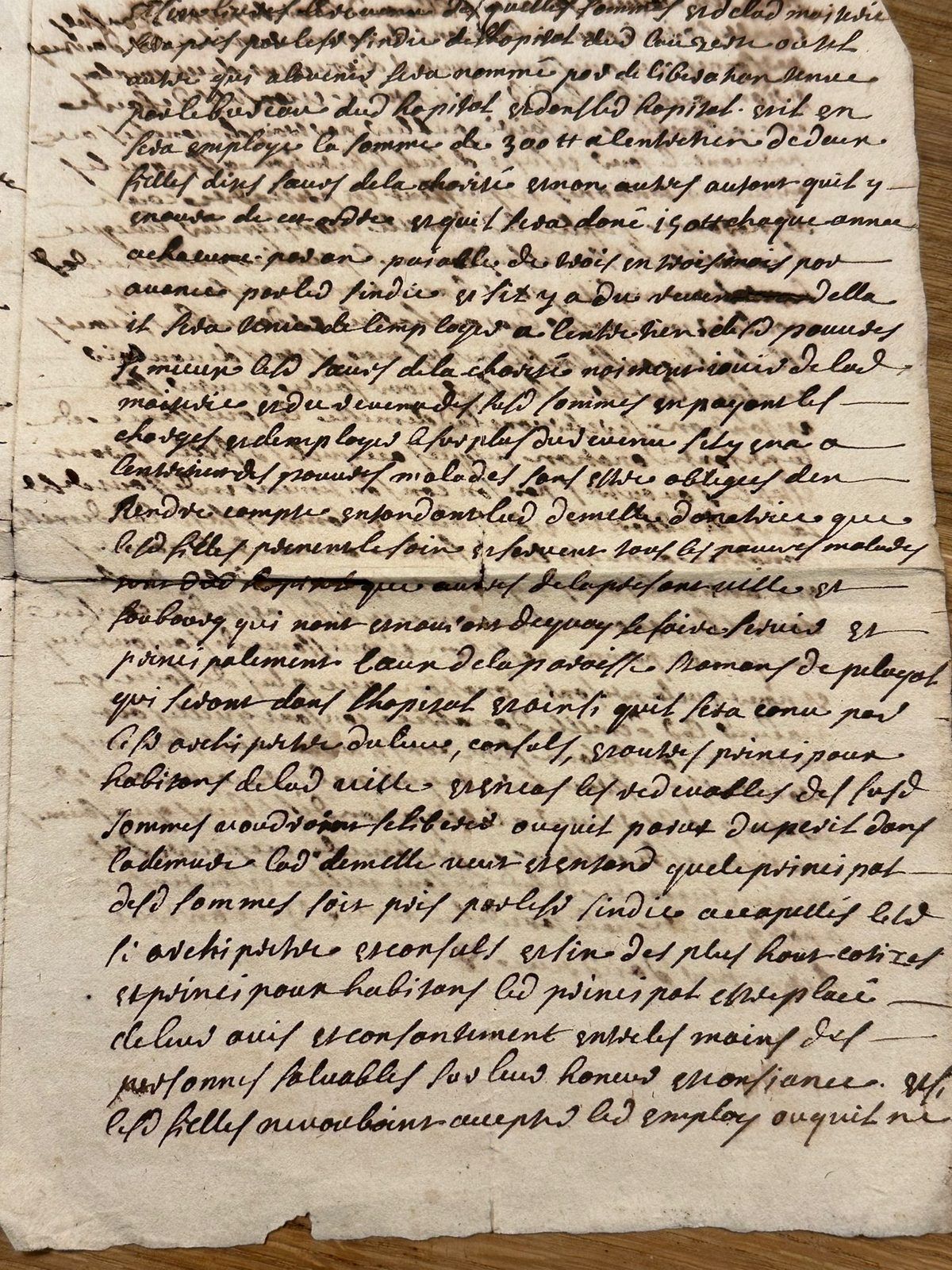
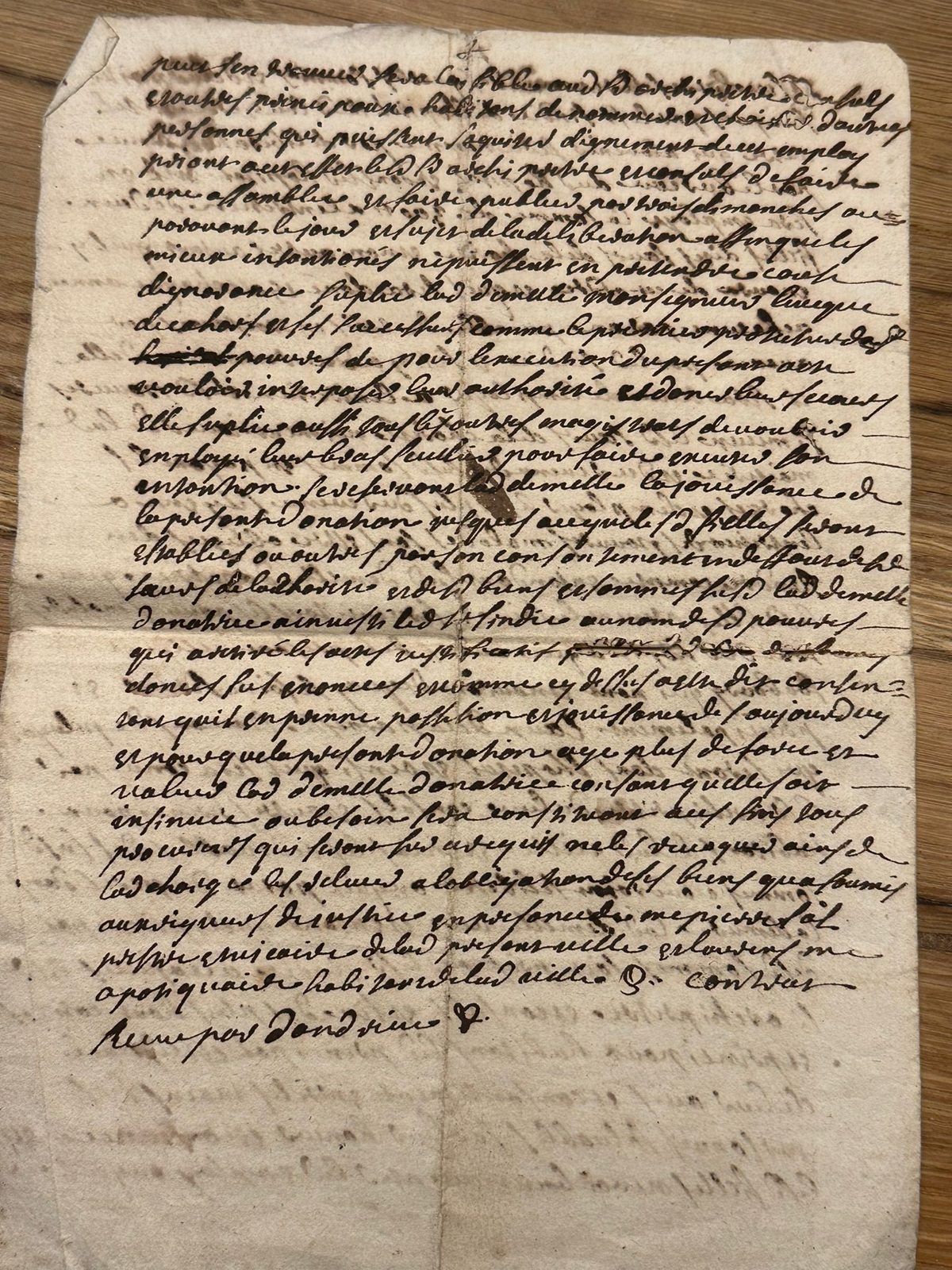
The gift of the Daucastel farm
“In the year 1711 and the eighth day of the month of September, in the town of Lauzerte”, before a royal notary, Demoiselle Fleur de Darnal makes a “pure, simple and irrevocable” gift to the sick poor of the town, suburb and hospital, represented by their syndic, Pierre-Louis de La Boissière. She gives them “a farm and estate called the Daucastel farm”, with the house, land, livestock and tools, valued at four thousand livres, plus two debts owed to her, including 1,716 livres due from the Baron of Beaucaire.
The deed spells out what the gift covers. The farm lies in the parish of Saint-Avit-Daucastel; Fleur adds a house in the parish of Saint-Symphorien. The Baron de Beaucaire’s debt, owed by François de Pechpeyrou, goes back to a contract of 16 May 1679 drawn up before a Toulouse notary; a second debt, of 250 livres, is owed by one Descayrac.
The deed also sets out how the income is to be used: three hundred livres a year to support two “Daughters known as Sisters of Charity”, who will serve the sick poor of the hospital and the town, and above all those of the parish of Saint-Amans-de-Pellagal.
Very strict conditions
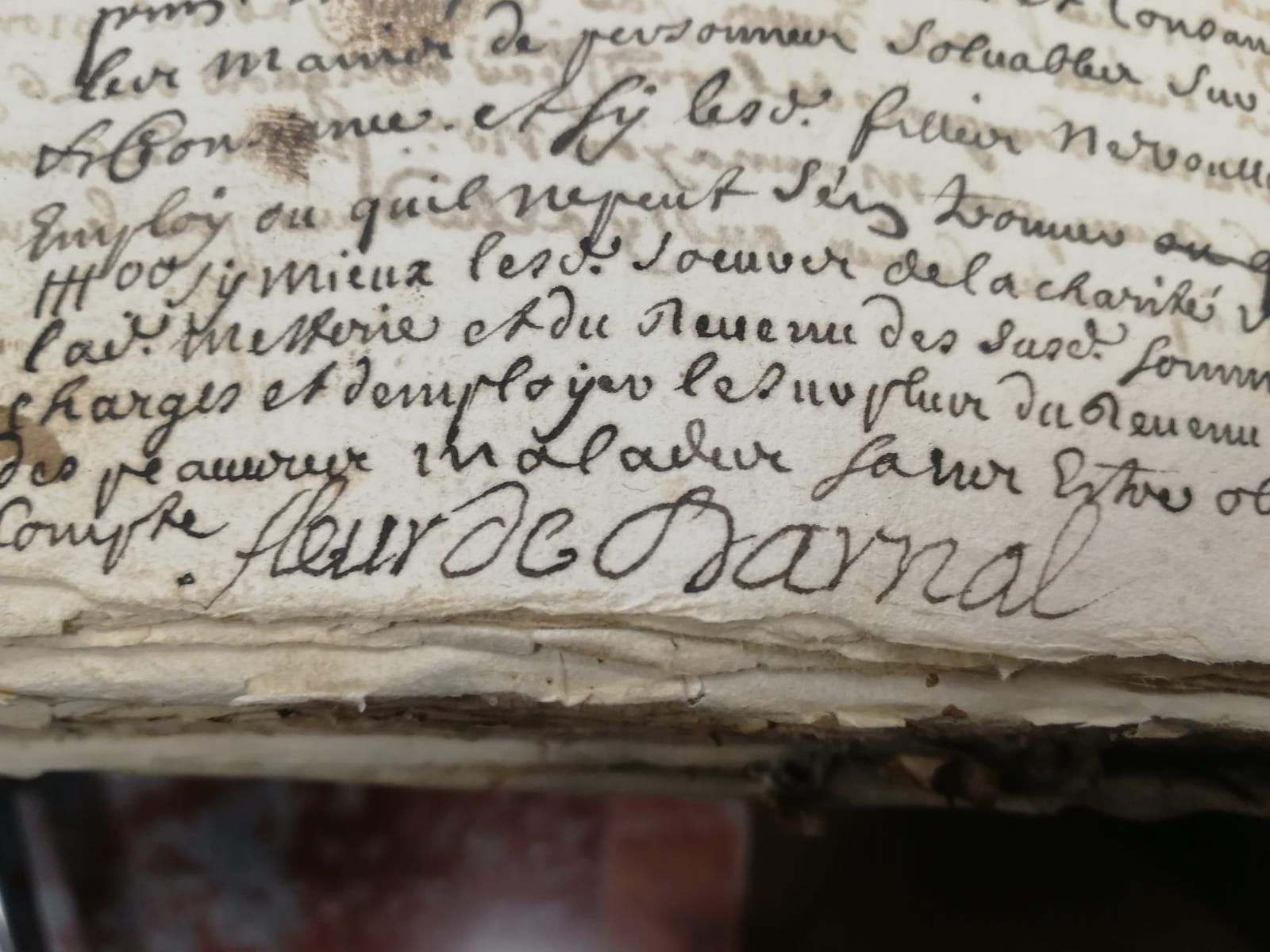
Fleur framed her gift with a lawyer’s precision. The 1711 deed is “irrevocable” and entrusts the bishop of Cahors and the magistrates with enforcing it. Her last will, of 2 August 1734, goes further: the hospital, her universal heir, must support three Daughters of Charity and have five hundred low masses said for the salvation of her soul and her family’s. Above all, it may only admit “the poor suffering from common… and not shameful diseases”: no “women of ill repute”, no “madmen”. Orphan girls are admitted, orphan boys are not. In 1897, more than a century and a half after her death, the will was still being used to defend the Daughters of Charity.
Daucastel, Aucastel, Haut-Castel
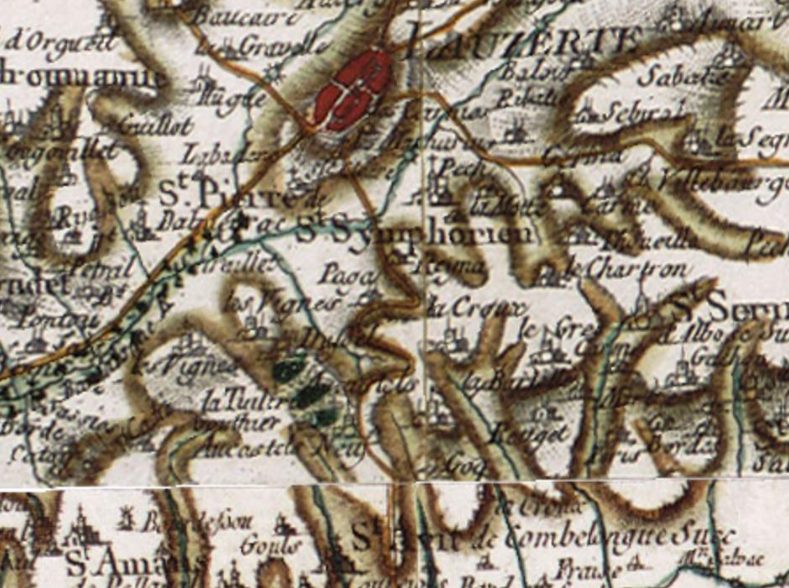
On the Cassini map, south of Lauzerte and Saint-Symphorien, a place is named “Aucastel”. In 1908 the hospice’s deed of sale describes “the Haut-Castel property, located at the hamlet of Tayssou”. Same name, same parish, same jurisdiction, same charitable owner: it is an established fact that this is one and the same farm. “Daucastel” in the 1711 gift, “Aucastel” on the Cassini map, “Haut-Castel” in the hospice’s records and in the 1908 deed: the name simply changed with the spelling, and the records of the hospice’s management, from 1739 to 1908, follow the property without a break.
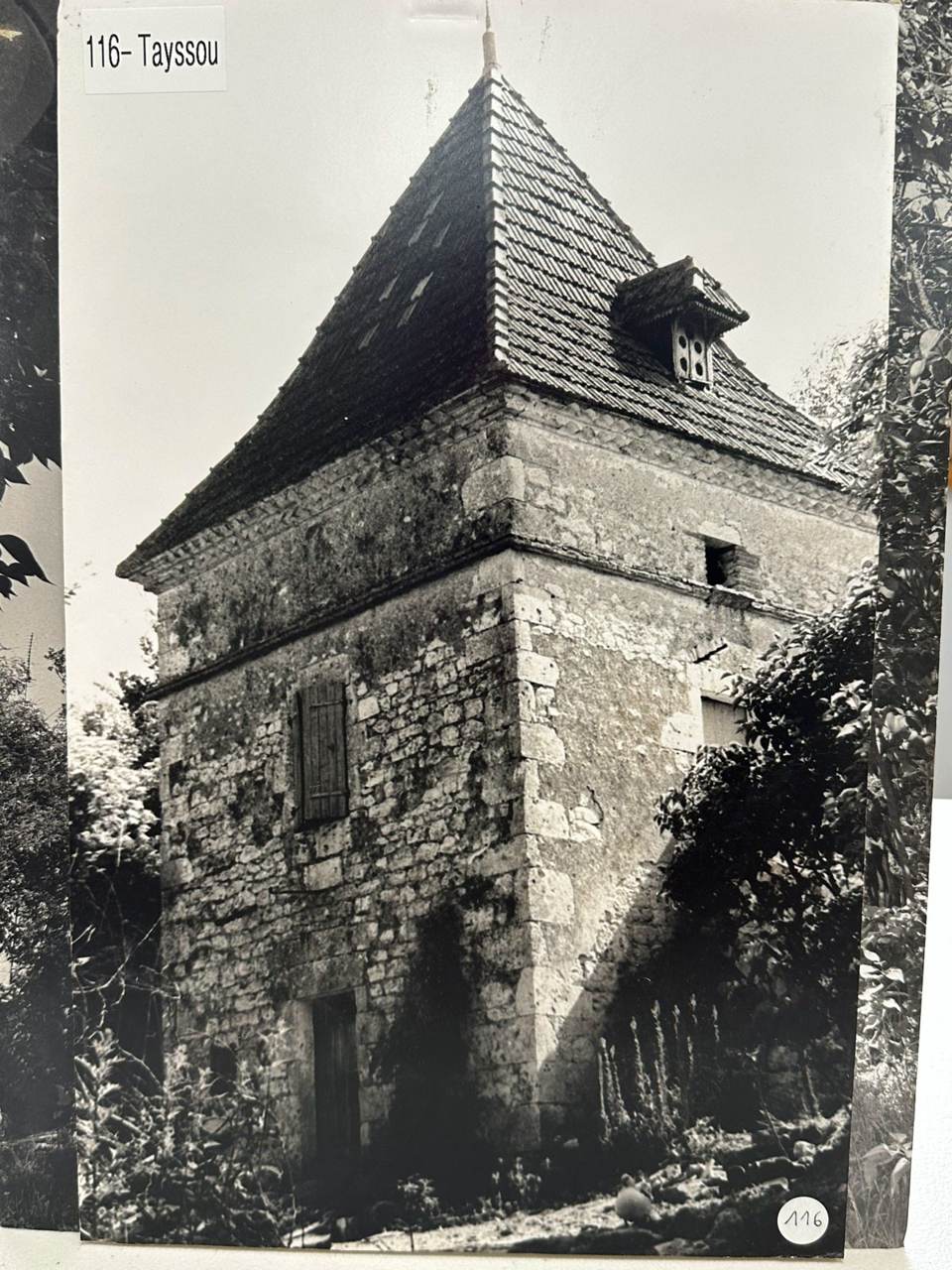
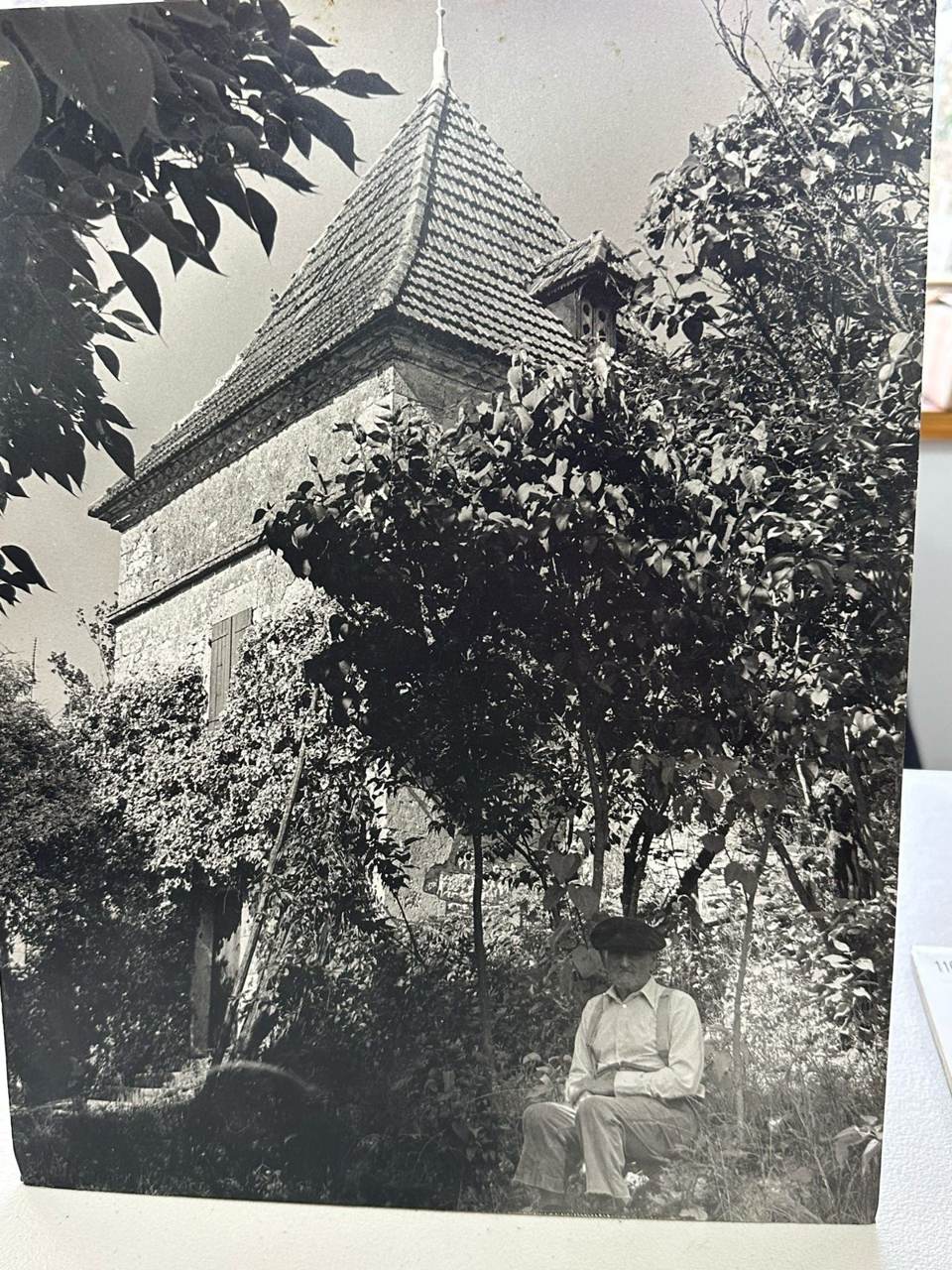
The dovecote, standing apart from the farmhouse, has four levels including a vaulted cellar. The 2021 study dates it to between 1700 and 1800. It also collected pigeon droppings, a highly prized fertiliser.
The death of Fleur de Darnal
Fleur never lived at Haut-Castel: it was one of her three métairies, Cadiot at Saint-Amans-de-Pellagal, Haut-Castel (today Tayssou) and a third at Saint-Symphorien, tenant farms worked by sharecroppers, which she probably inherited from her brother Pierre on his death in 1710. Fleur dies on 13 March 1739, aged about 79. Her death record calls her “founder of the Sisters of Charity at the hospital of this town”. Her will names the hospital as universal heir and provides for three Daughters of Charity. She is buried in what is now the Carmelite chapel, in the Auriac quarter.
Why a farm, not a home? The Darnal family never lived at Haut-Castel. For these families of lawyers and burghers, divided between Toulouse and Lauzerte, land was above all a safe investment: they bought farms around the town and entrusted them to sharecroppers, who worked them and shared the harvest half and half with the owner. Wheat, wine, livestock and dues in kind filled the lofts of the town house and upheld the family’s standing. We do not yet know how Daucastel entered their estate, probably through purchase or inheritance in the 17th century. The 1711 deed says only that Fleur held it “in the form and manner” in which her father and her brother had held it. It was this income, not a family home, that she chose to give to the poor of Lauzerte.
How did the farm come to the Darnals? The 1711 deed says only that Fleur holds it, as heir, from her father and her brother. The Lauzerte registers take us further, as long as we separate what is established from what remains to be proved.
- Established. Fleur is the daughter of Arnaud Darnal, doctor of law and barrister, and Jacquette de La Bonne. Born in Lauzerte on 21 June 1660 “between one and two in the morning”, she is baptised on the 26th; her godfather is Charles Darnal, her godmother Fleur de La Bonne, wife of a Toulouse merchant, who gives her her name.
- Hypothesis. Arnaud would be the son of Charles Arnal (1590 – after 1646), doctor of law and barrister at the parlement, and Antoinette Fabri, married in Lauzerte on 28 February 1621: an Arnaud is born to them on 1 February 1622, followed by Antoine, Marguerite and Antoinette. Charles Darnal standing as Fleur’s godfather supports this. Charles would himself be the son of Arnauld Arnal, a burgher of Lauzerte, and Anne Rinati, married around 1585.
- Consequence. If this line is confirmed, the farms probably came into the family in the early 17th century, around the 1621 marriage, by inheritance or dowry from the allied families: the Fabris and the Sapieties, procurators at the Lauzerte court from father to son, or the Rinatis.
- Another lead: a debt settled in land? The 1711 gift mentions a claim of 1,716 livres on the Pechpeyrou, barons of Beaucaire, close to Lauzerte; such loans were often settled by handing over a farm.
Sources: Tarn-et-Garonne departmental archives, Lauzerte parish registers (3 E 094-1 to 3, including Fleur’s baptism in 1660) and the notary Lanier’s records (5 E 5669, 1645-1651); “basquercy” family tree on Geneanet ↗. Still to be searched: the Lauzerte land registers (compoix) and the marriage contracts of 1621 and 1649.
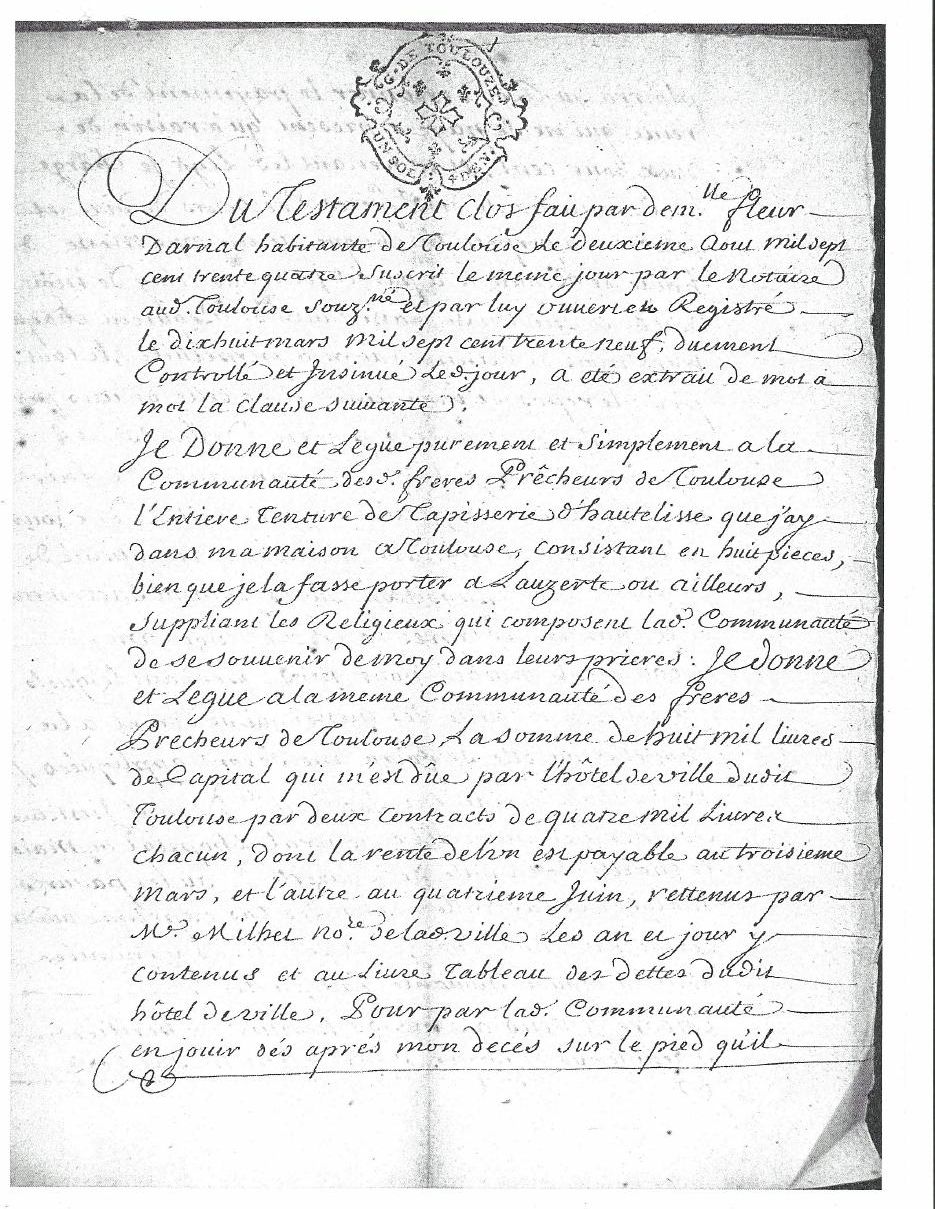
Having settled in Toulouse in her later years, Fleur draws up a second act there on 2 August 1734: a sealed will confirming and clarifying the provisions of the 1711 gift, and adding her Toulouse bequests. An extract was issued by the notary Pierre Richard. Fleur, “living in Toulouse”, leaves the convent of the Friars Preachers, the Jacobins, her set of eight high-warp tapestries and a capital of eight thousand livres owed by Toulouse city hall. In return, the friars are to celebrate a high requiem mass every year on the day of her death, a low mass every three months and a ten-day retreat. The same act names as universal heir “the hospital or house of charity of the town of Lauzerte, or the sick poor of the said town”.

The Napoleonic land register
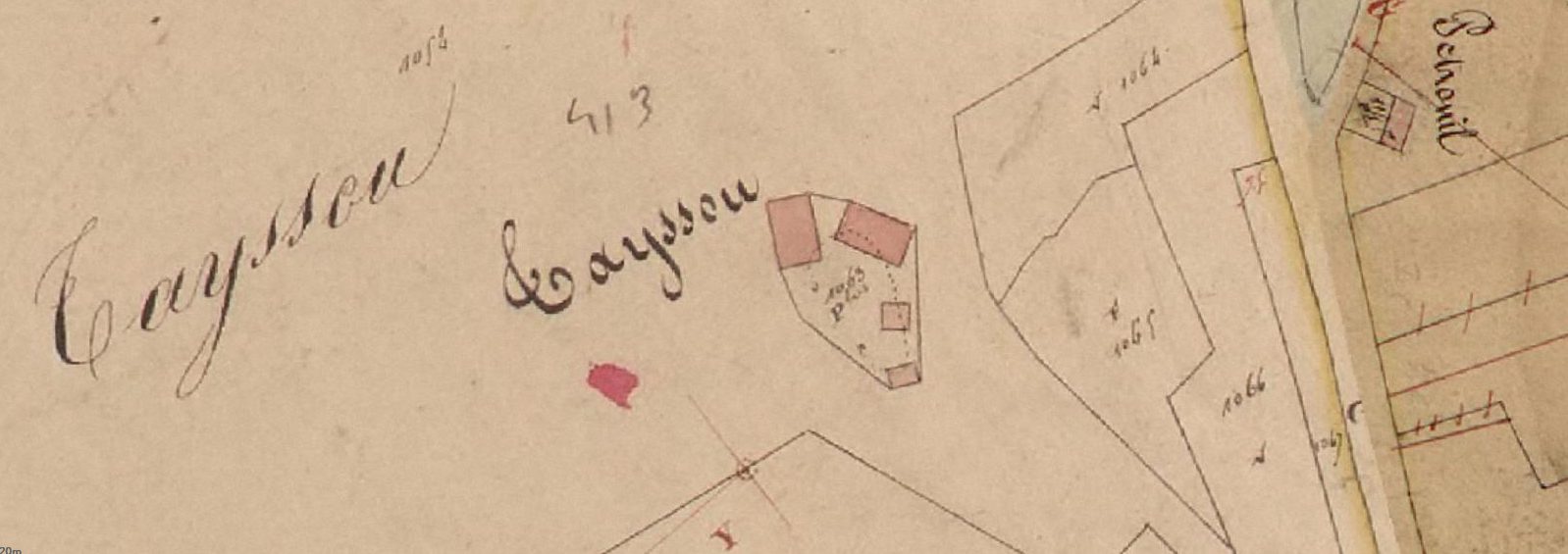
Lauzerte’s first cadastral plan shows the group already in place at Tayssou: farmhouse, barn, dovecote and outbuilding around the yard. The barn is extended southwards in the second half of the century. By the end of the century the farm belongs to the hospice; the last lease is granted in 1899 to Jean Pons and Julie Delpech.
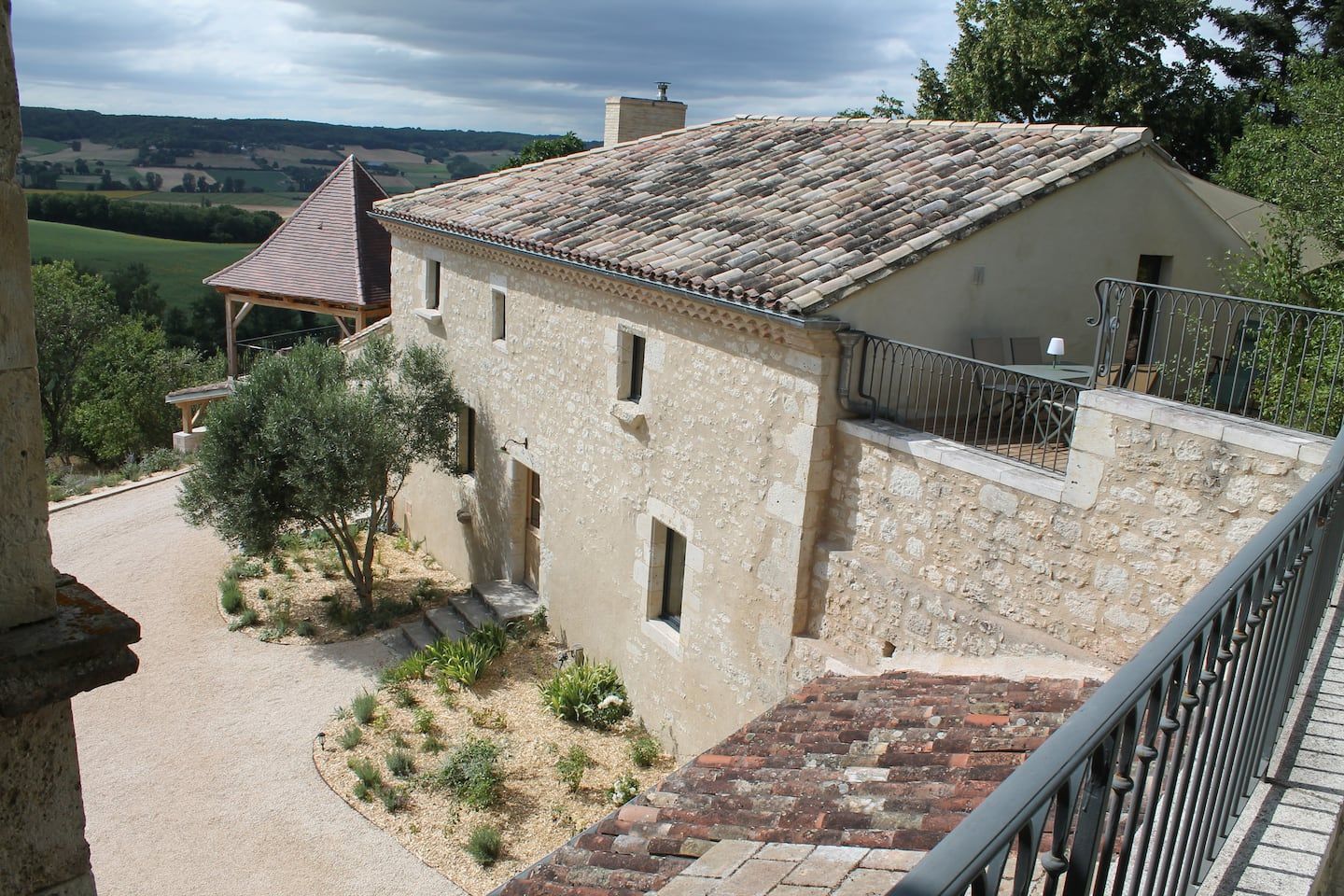
The group follows the layout of Quercy Blanc farms: the farmhouse, reached by an outside stone staircase; the long barn and byre; the dovecote, a free-standing tower under a pyramid roof; the outbuilding closing the yard. Walls are of local limestone rubble bound with lime, with dressed-stone quoins and openings; the low-pitched roofs of canal tiles rest on génoise eaves. A sober rural architecture, without ornament, whose quality lies in its proportions and its stone.
Property of the poor, run as public property
Through the 1711 gift, then on Fleur’s death on 13 March 1739, the farm passed to the hospital of Lauzerte. It would stay there for almost two centuries. As property of the poor it was managed with the rigour of public property: nothing was decided without a resolution of the hospice’s administrative board, chaired by the mayor, the opinion of the town council, then the approval of the sub-prefect in Moissac and the prefect of Tarn-et-Garonne in Montauban.
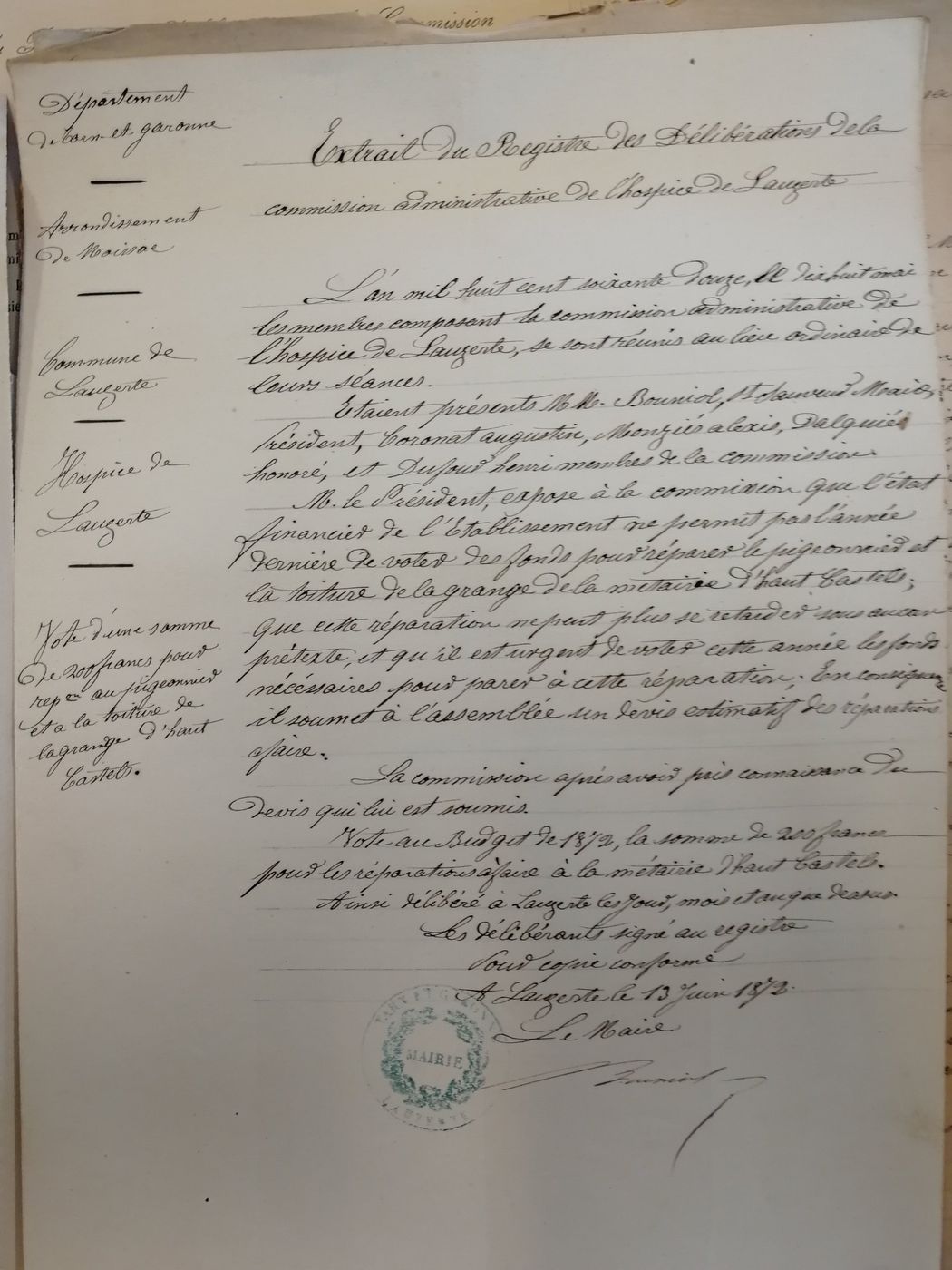
This meticulous administration left a wealth of documents in the Tarn-et-Garonne departmental archives, which we began photographing and digitising in 2021. Around 1800, a hospice register already describes the “métairie Daucastel, consisting of the buildings…”. Throughout the 19th century, every expense, however small, climbed the administrative ladder:
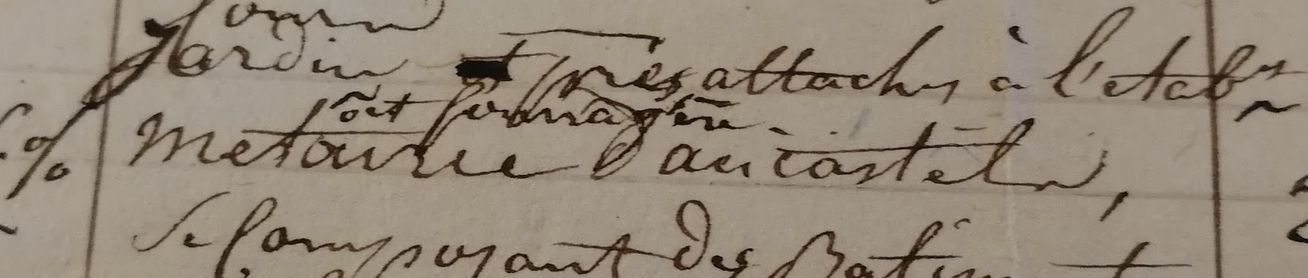
- 1872: the board votes 200 francs to repair “the dovecote and the barn roof of the Haut-Castels farm”, a repair that “can no longer be put off on any pretext”.
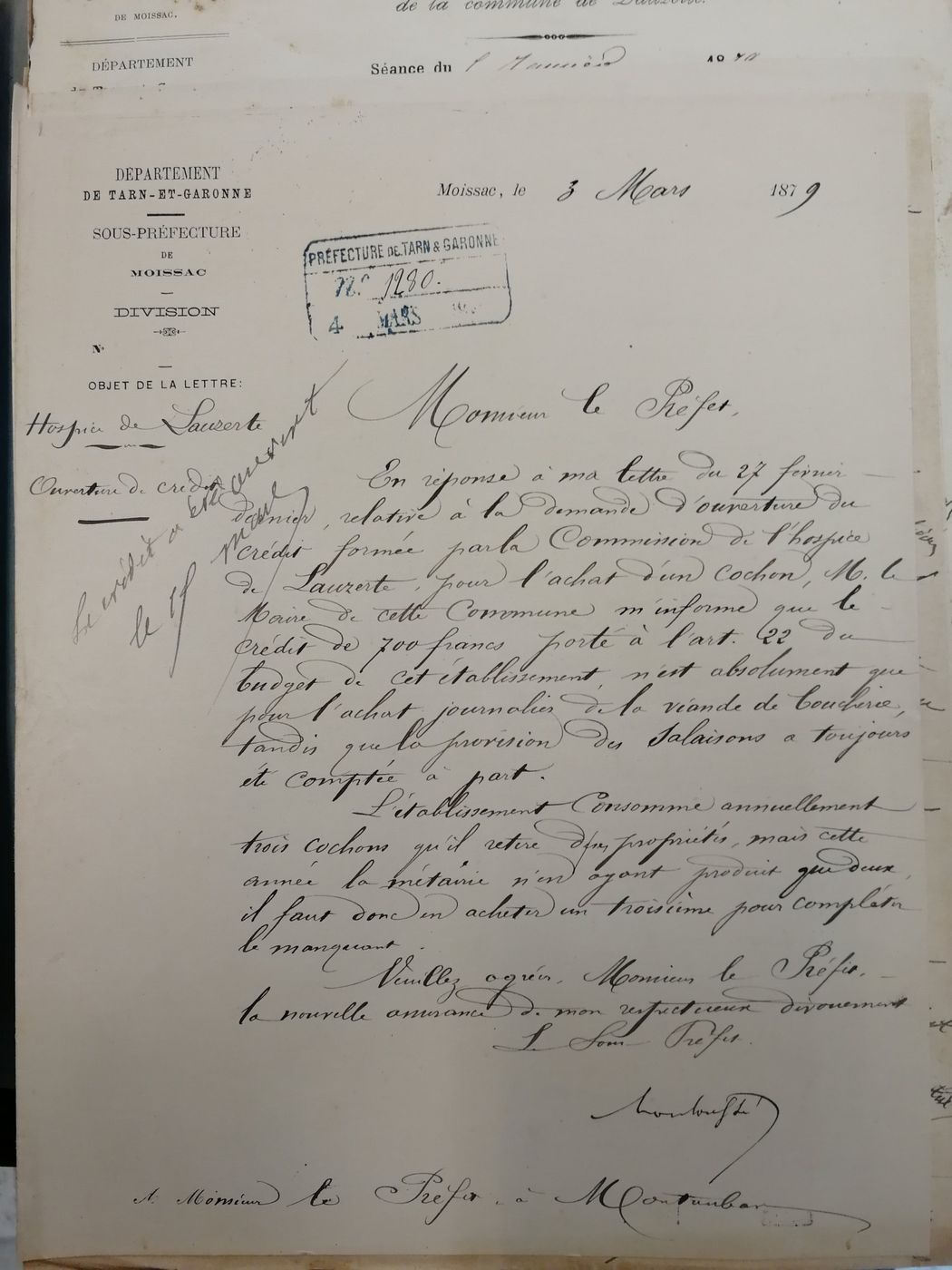
- 1879: the sub-prefect explains to the prefect that the hospice eats three pigs a year from its own farms; as the farm has produced only two, a credit is needed to buy the third. Same again in 1880.
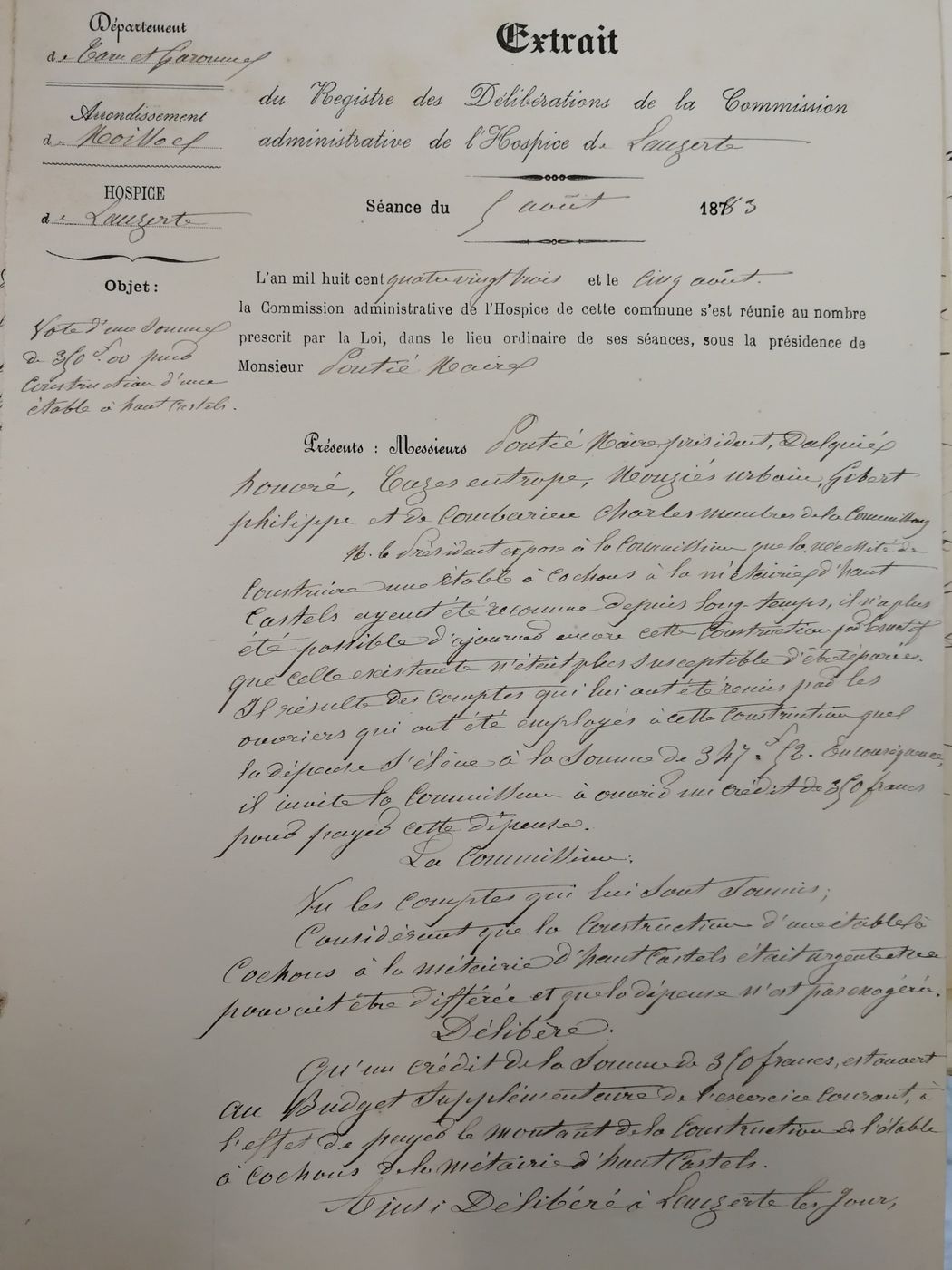
- 1883: a pigsty is built at Haut-Castels for 347.52 francs. Resolution of the hospice, the town council’s opinion the same day, forwarding by the sub-prefect, then the prefecture worries about the balance of the supplementary budget.
- 1899: with no sharecropper since Michaelmas, the farm is worked by day labourers; the board decides to let it to tenant farmers, the Pons couple from Saint-Amans-de-Pellagal, and asks the hospice secretary to oversee its farms. The prefect approves in 1900.
- 1905: the hospice decides to sell. Specifications, a public inquiry “de commodo et incommodo”, a prefectoral order: the Haut-Castel farm, about 25 hectares according to the land register, is put up for auction at a reserve of 12,000 francs, the proceeds to be invested in government stock.
Yet it would take three years, a second public inquiry and a new opinion from the prefect before the sale went through, in 1908.
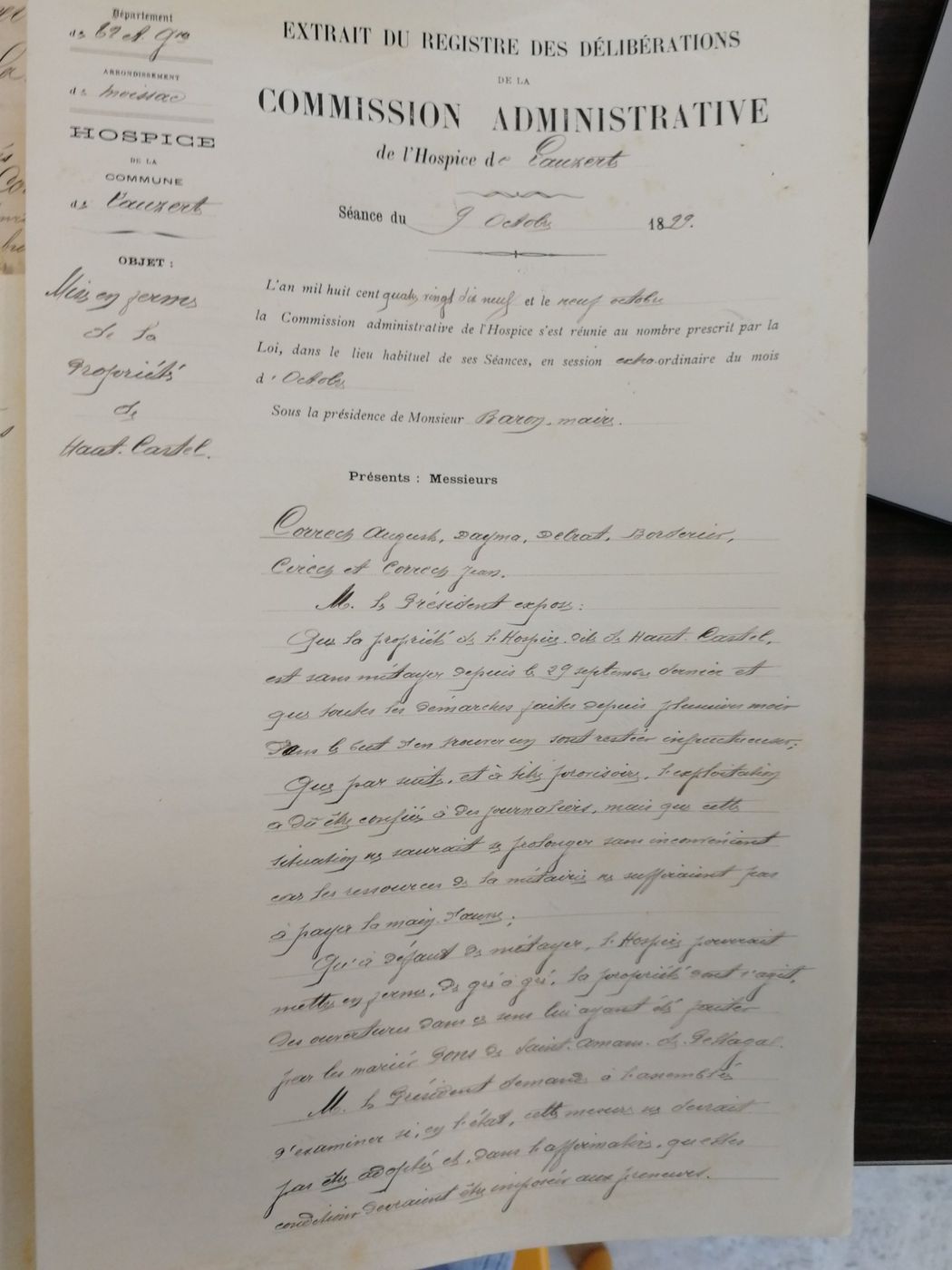
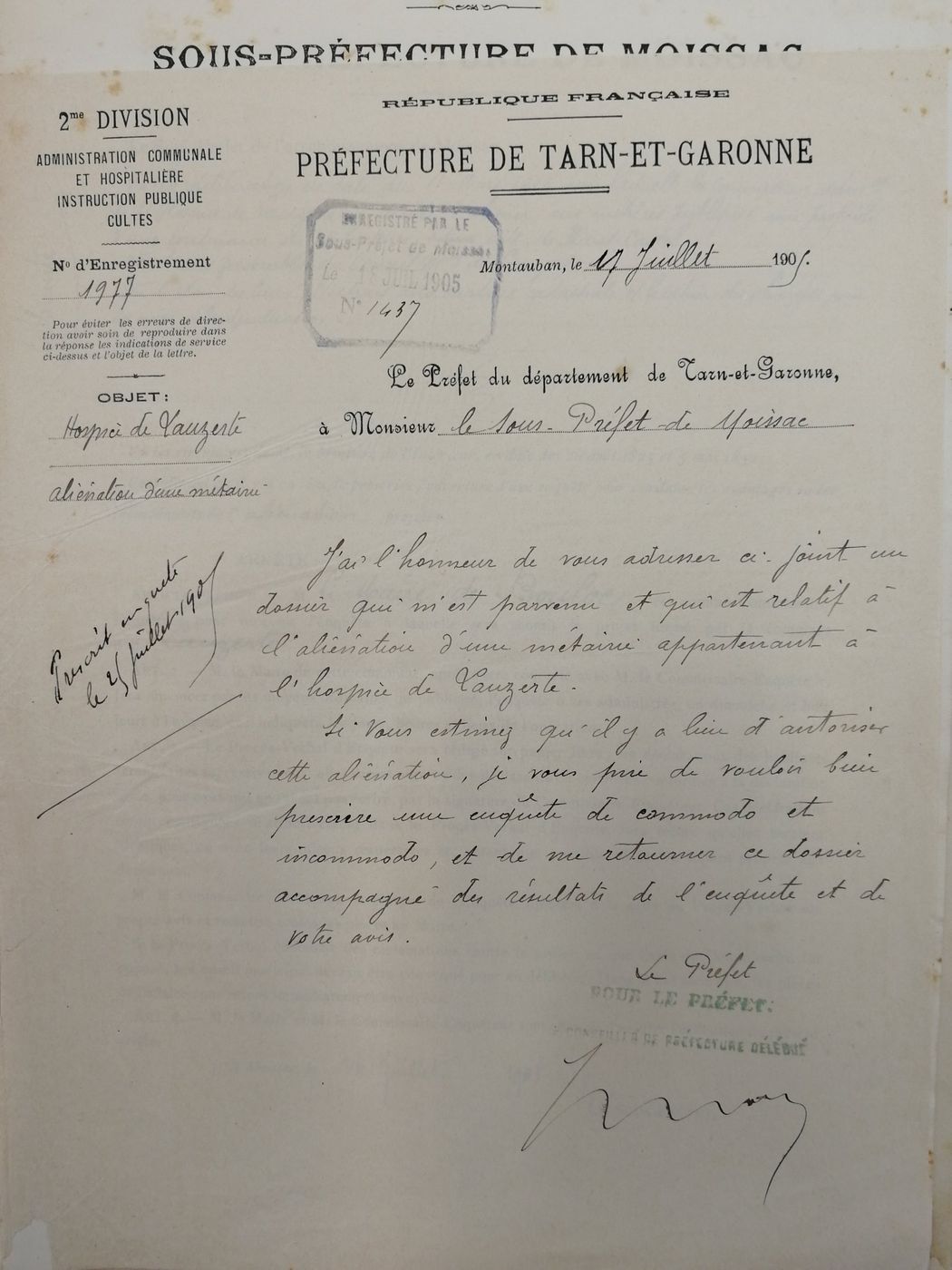
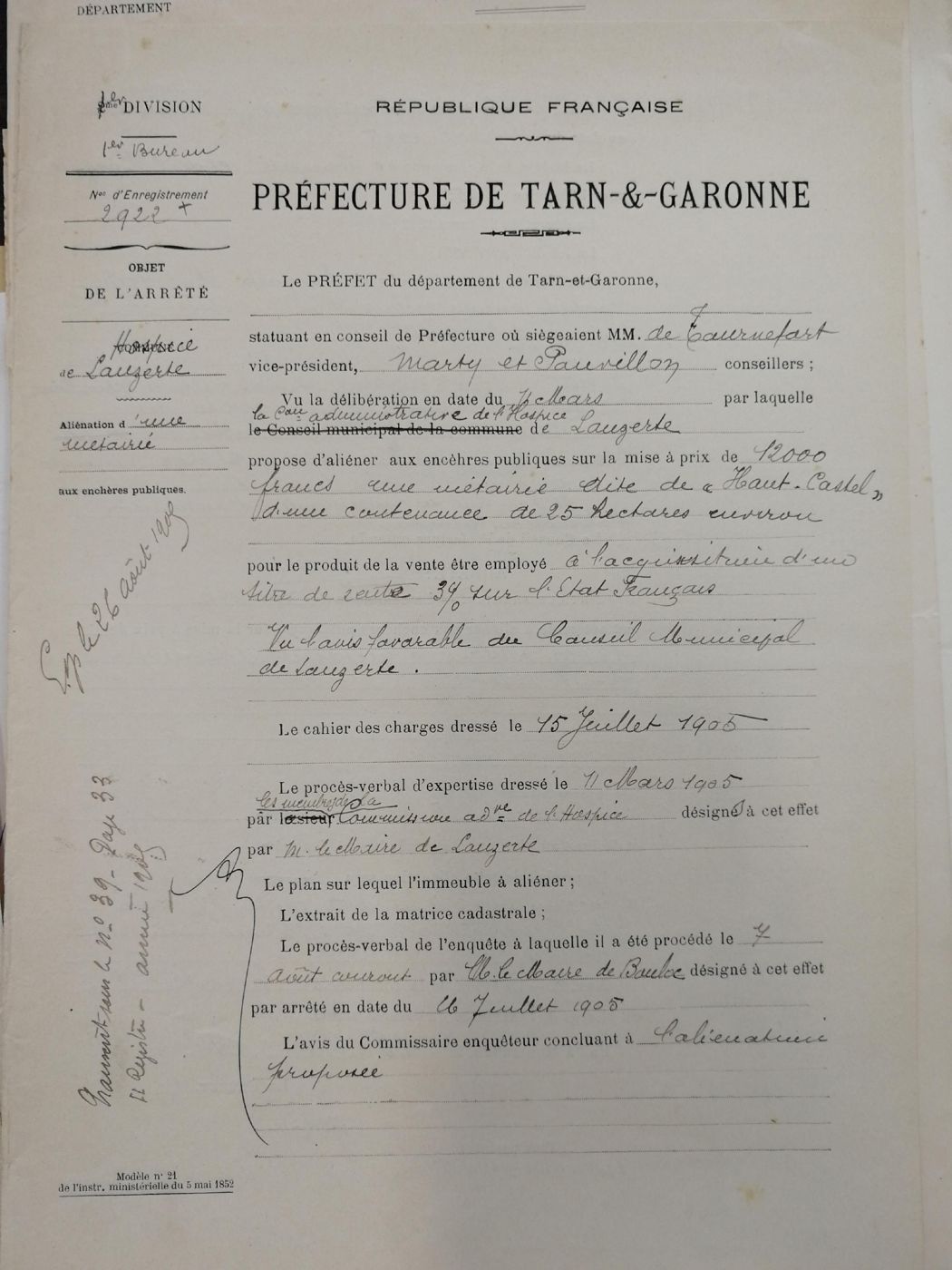
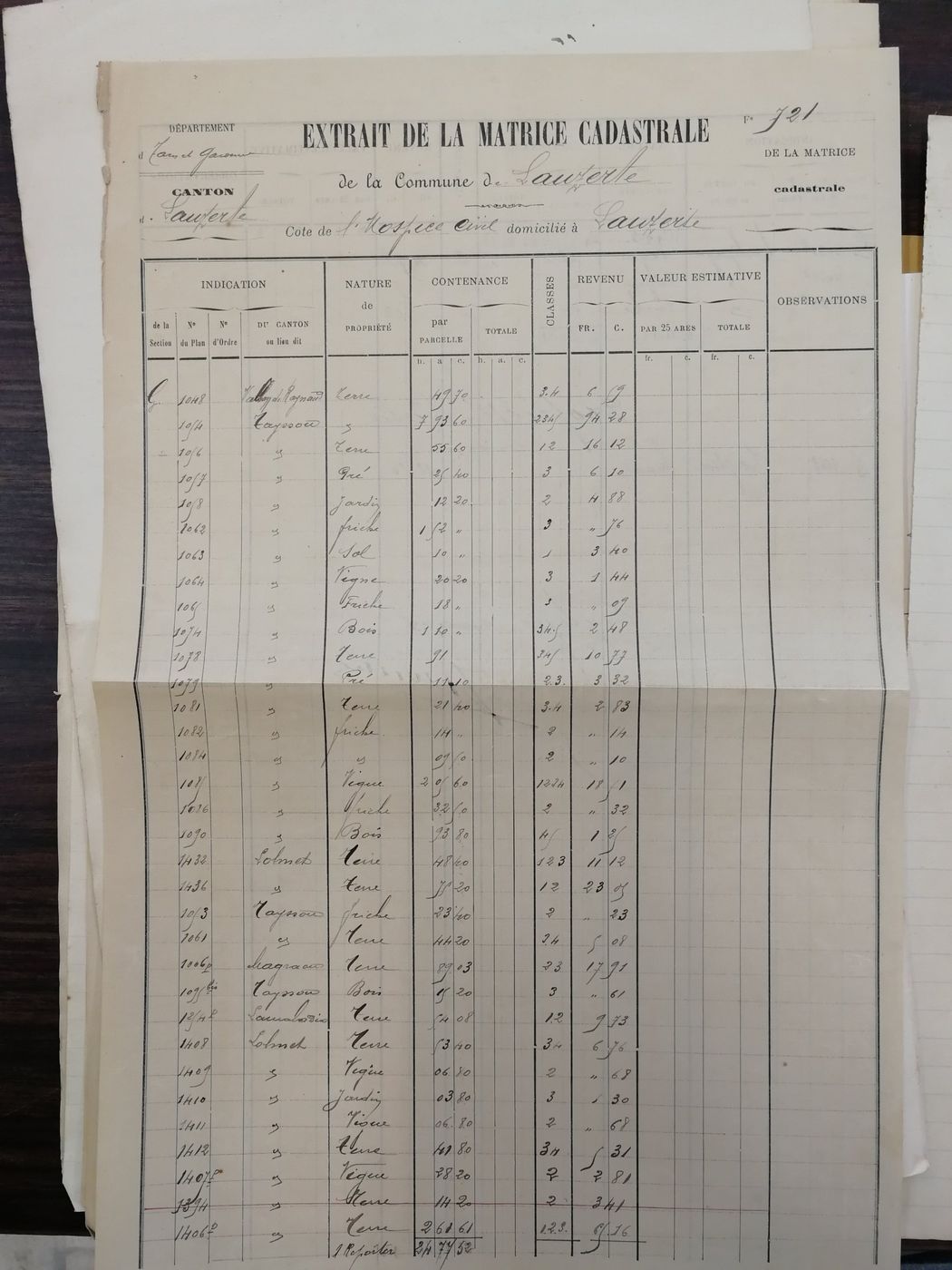
The hospice sells Haut-Castel
After a procedure begun in 1905 and delayed by the outgoing tenant’s claims, the prefect authorises the sale on 7 April 1908, judging the farm “in a poor state of cultivation”. The deed is signed before Maître Henri Borderies, notary in Lauzerte: Jean-Albert Salevieilles, a farmer from Larché, buys for 7,000 francs the “dwelling house, barn, dovecote and other buildings, arable land, meadows, woods, vines, garden”, some 18.5 hectares, threshing roller included. The farm passes from the poor to a family of farmers.
The deed, signed on 6 October and registered on the 9th, is signed by Génulphe Pontié, mayor of Lauzerte and chairman of the hospice board. It lists twenty-three land-register plots, 18 hectares 51 ares 30 centiares in all, three of them at Marty-Paga, acquired by the hospice through an exchange in 1894. The 7,000 francs, around €28,000 today according to INSEE, are paid in cash to the tax collector acting for the hospice; the prefect requires them to be invested in 3% government bonds for the benefit of the sick. The hospice keeps ten poplars, to be felled within two months.
Until 29 September 1908 the farm was worked by tenants Jean Pons and Julie Delpech, of Saint-Amans-de-Pellagal, whose claims had delayed the auction authorised as early as 1905. The buyer, Jean-Albert Salevieilles, known as Adrien, born in Lauzerte on 24 November 1881, son of Jean Salevieilles and Élisabeth Rouby of Larché, had married Marie Marty at Montagudet on 26 February; she was born on 25 December 1888, the daughter of Jean Marty and Marie Ambourieu. Their children, Lucie and René, were born in Lauzerte: Lucie the following 3 July, René in 1914. A new family settled at Tayssou for almost a century. Lucie and René would live there peacefully all their lives, without children of their own, yet never alone: the farm would shelter a child hidden during the war, then, for decades, the friends and neighbours who called in at “la Granisse”.
A refuge in wartime
According to testimony gathered in 2021, a child from Bordeaux was hidden at Tayssou during the Second World War. We know neither the circumstances nor how long he stayed. The bond was never broken: sixty years later, the property would be left to him.
Eighty years from the air
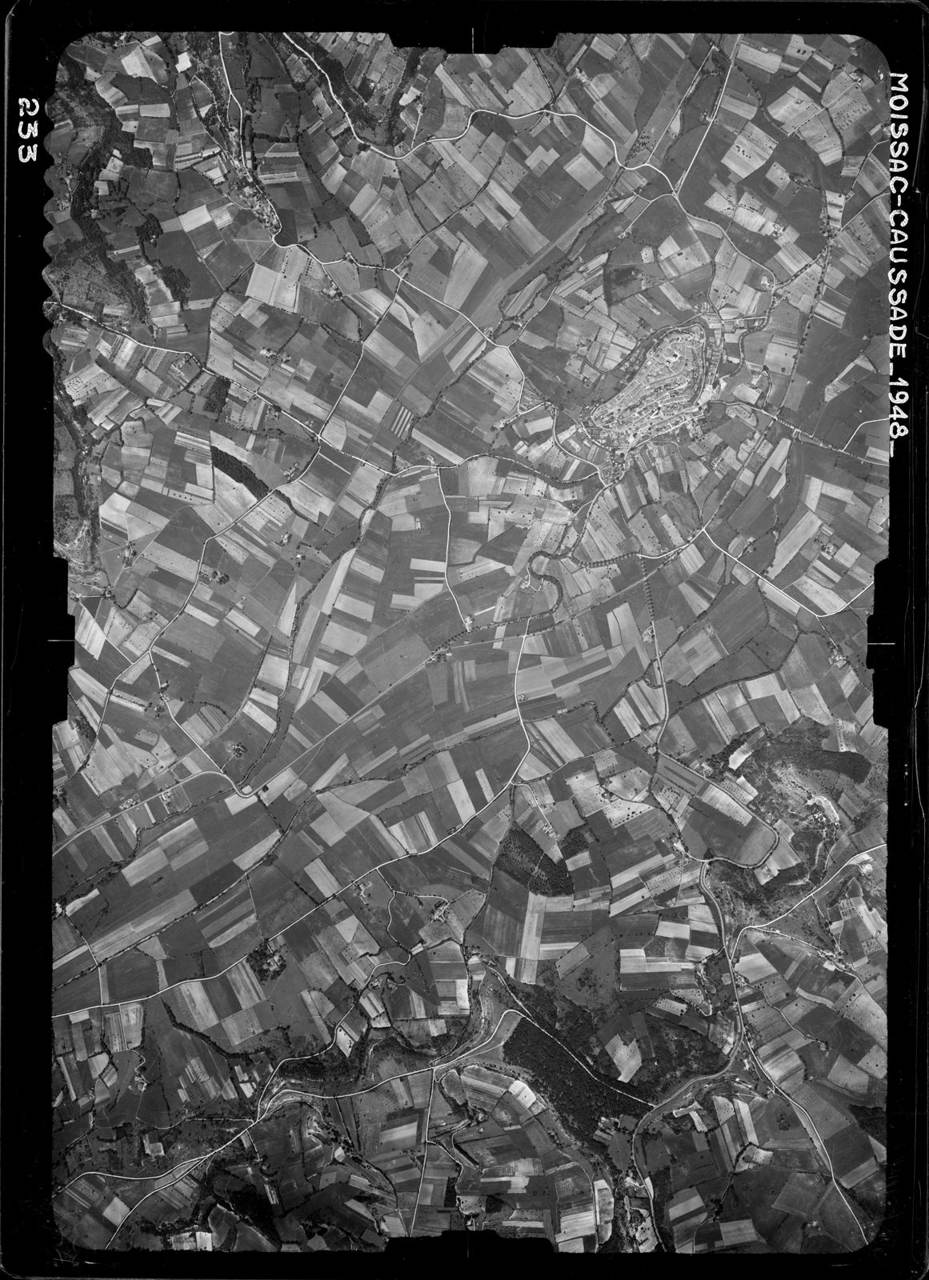
Some twenty aerial views, from IGN to Google Earth and our own drone, aligned on the same framing, tell the story of the Salevieilles’ farming life: strip fields, orchards, vines, then land consolidation, abandonment and rebirth. Pick a year or swipe the image.
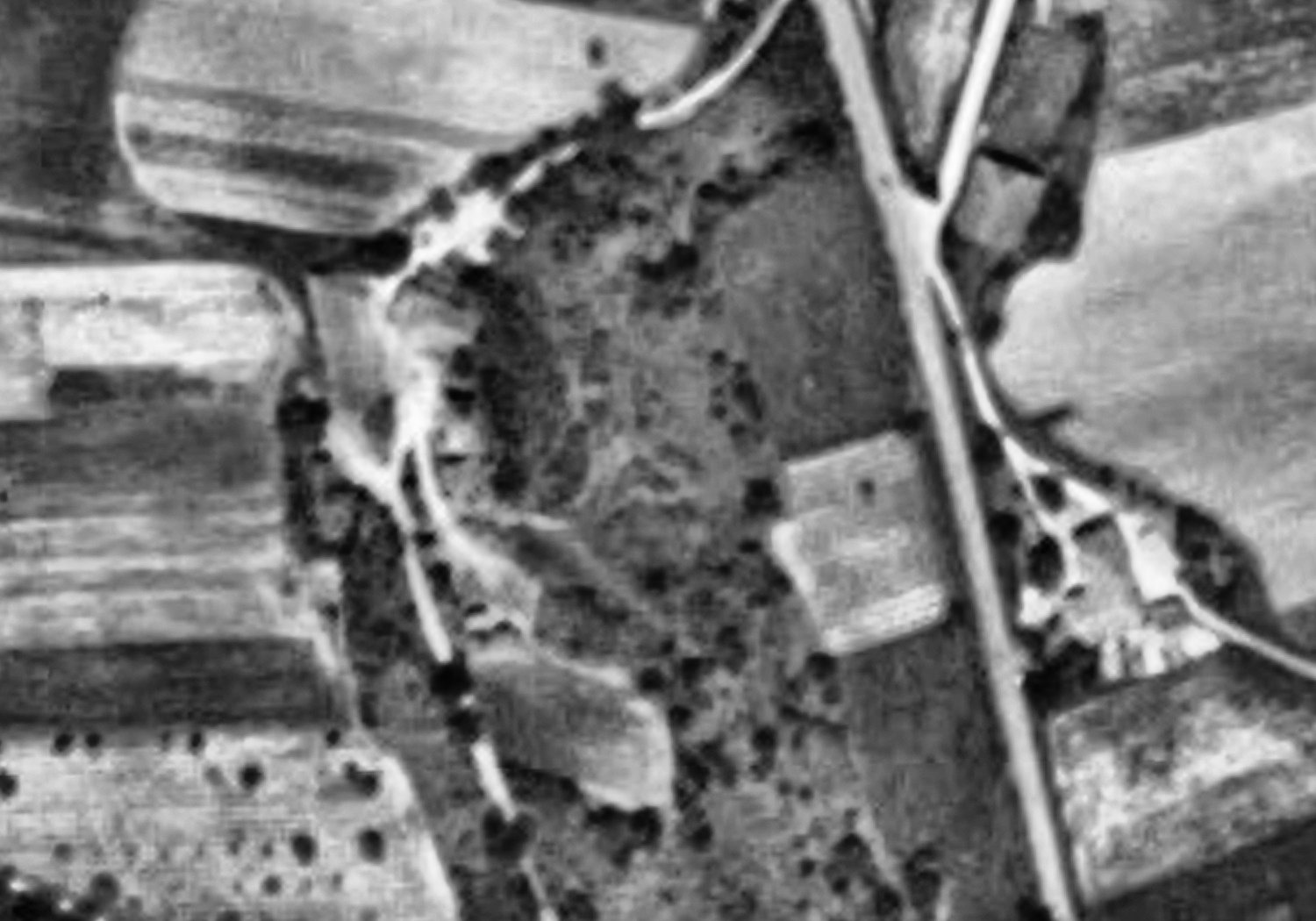
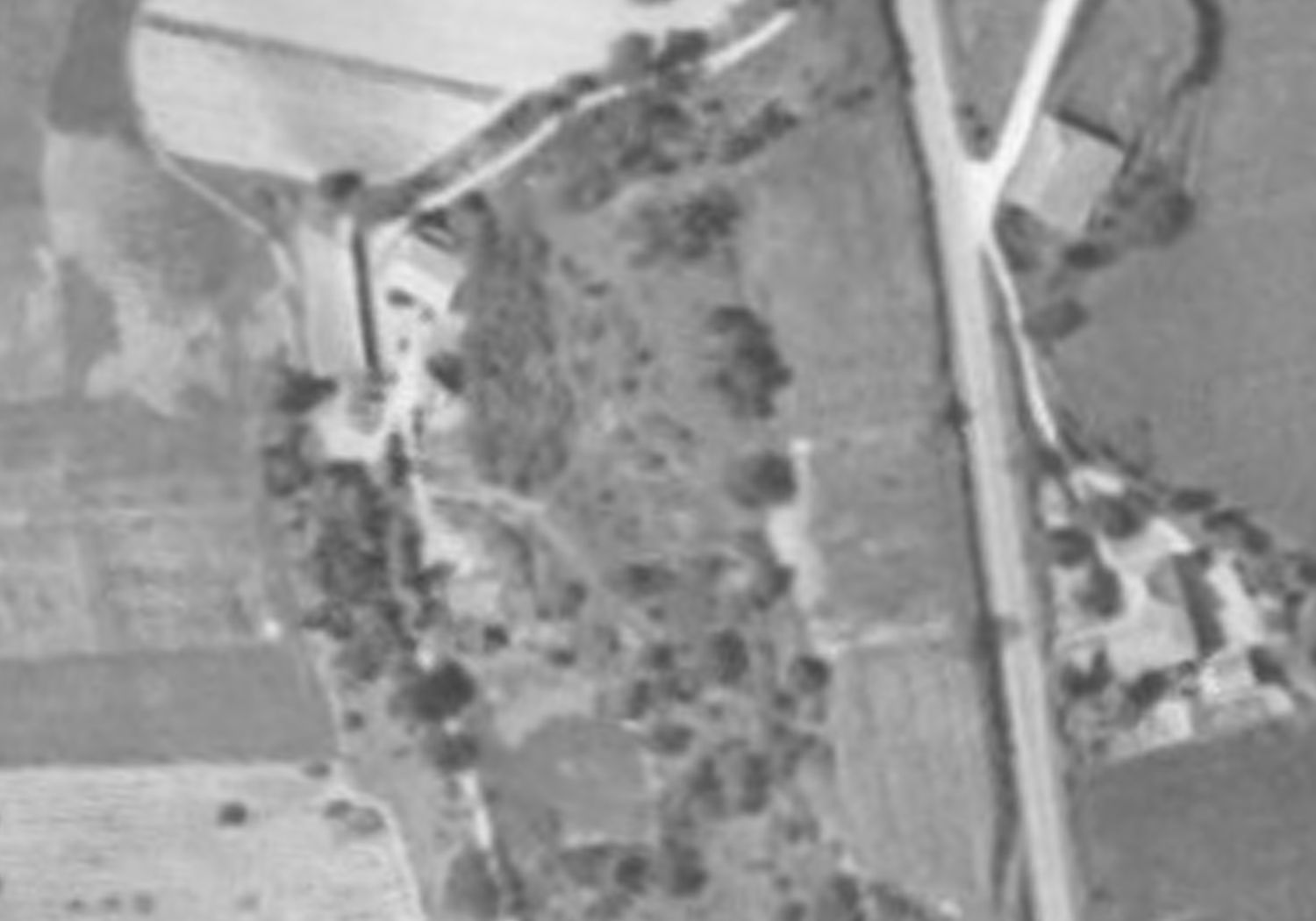
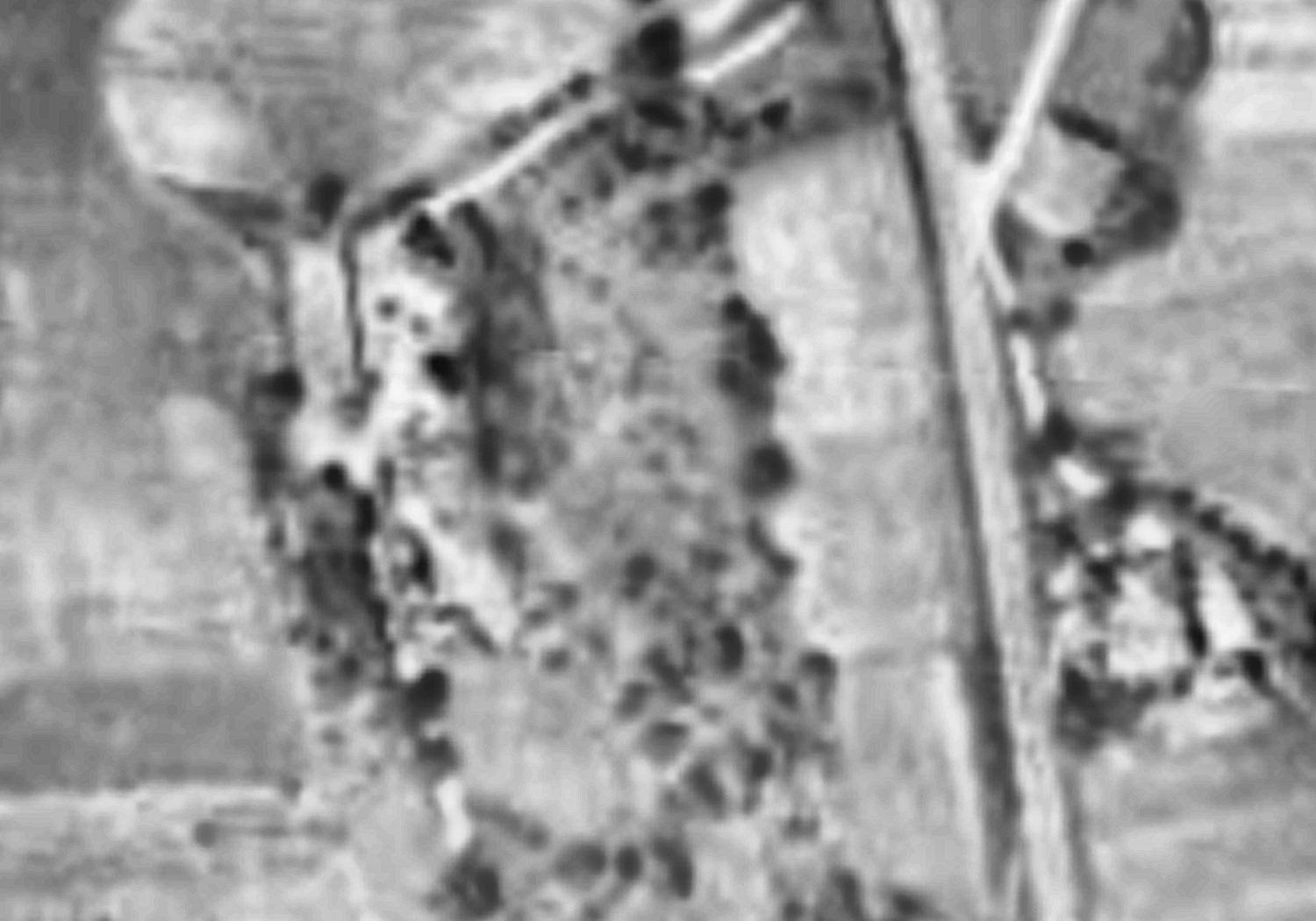
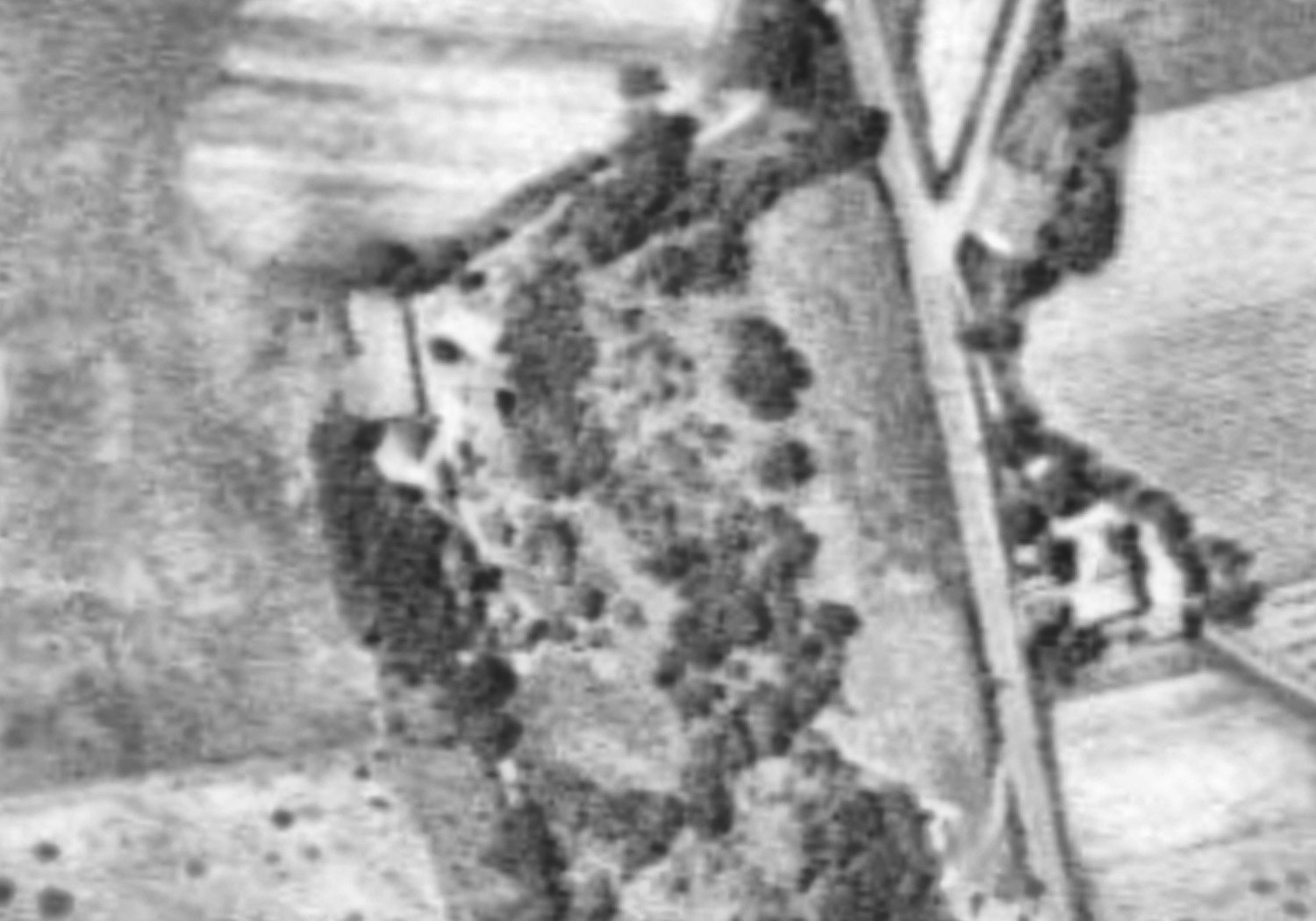
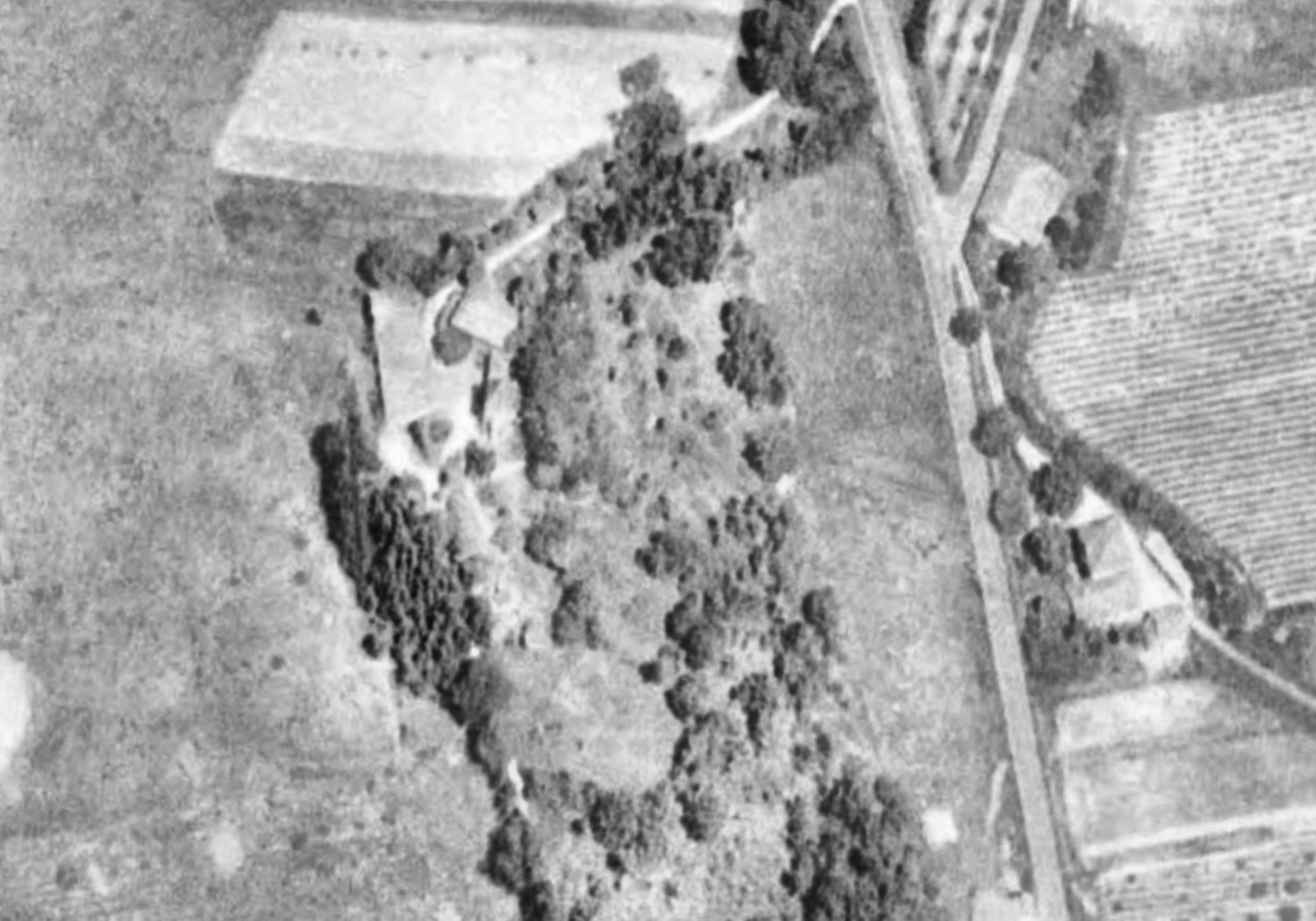
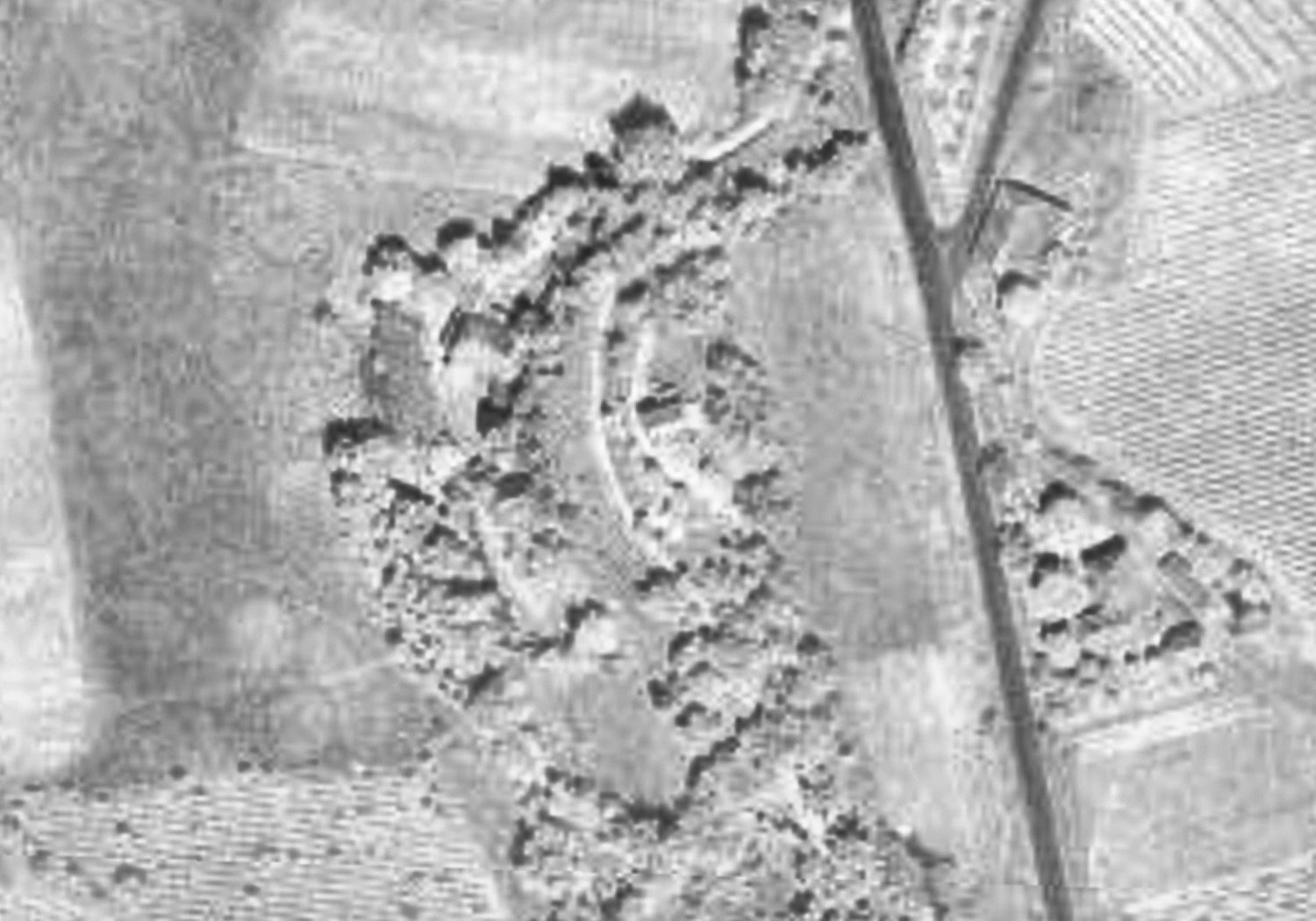
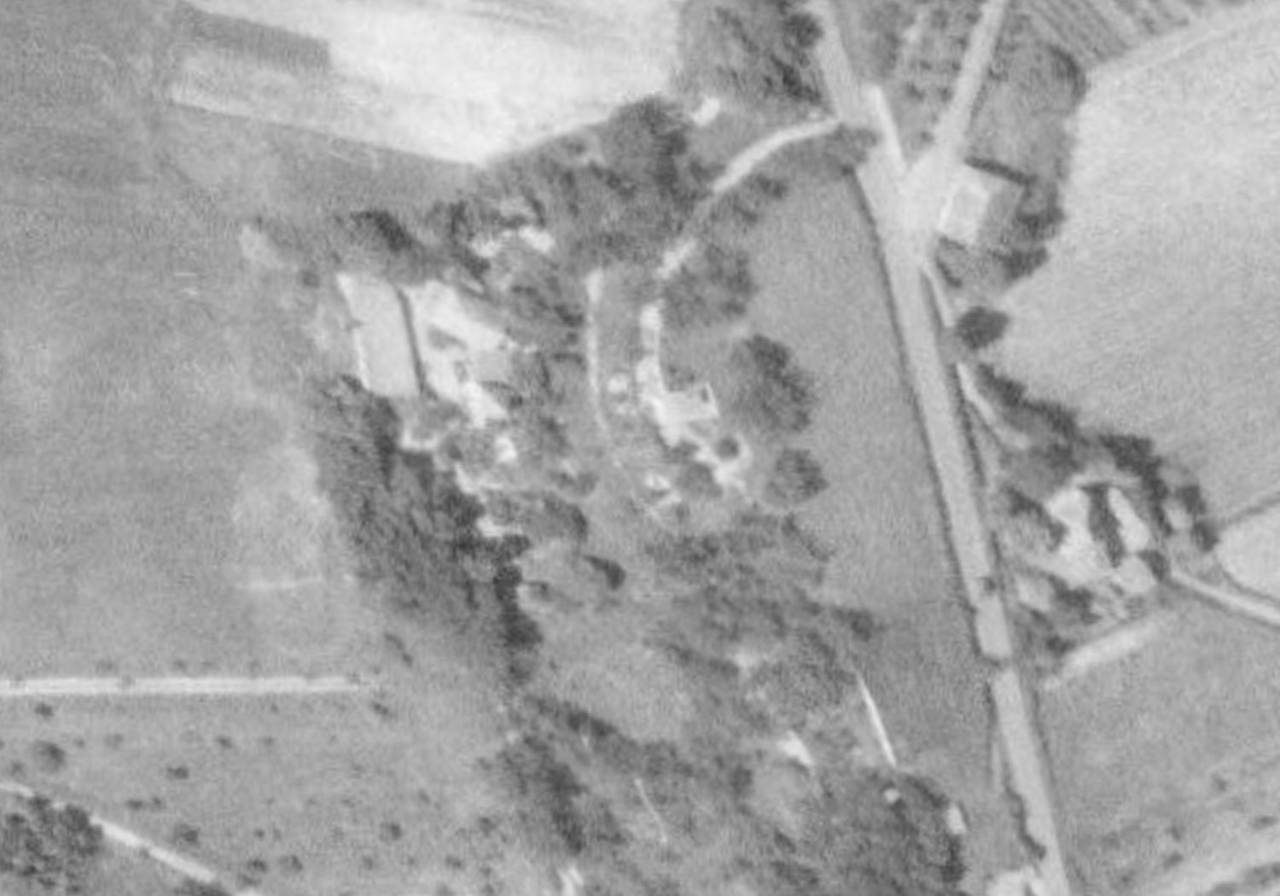
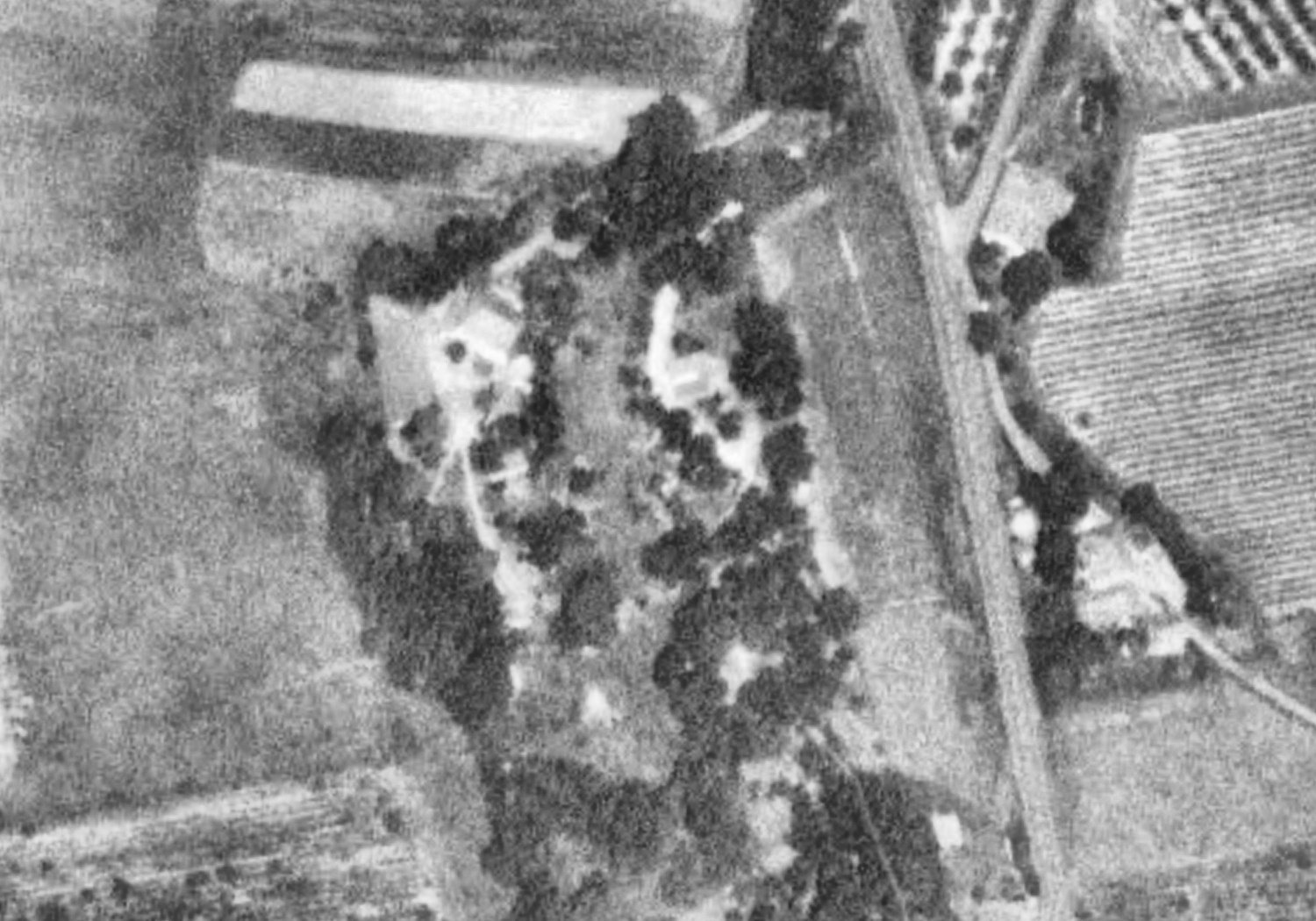
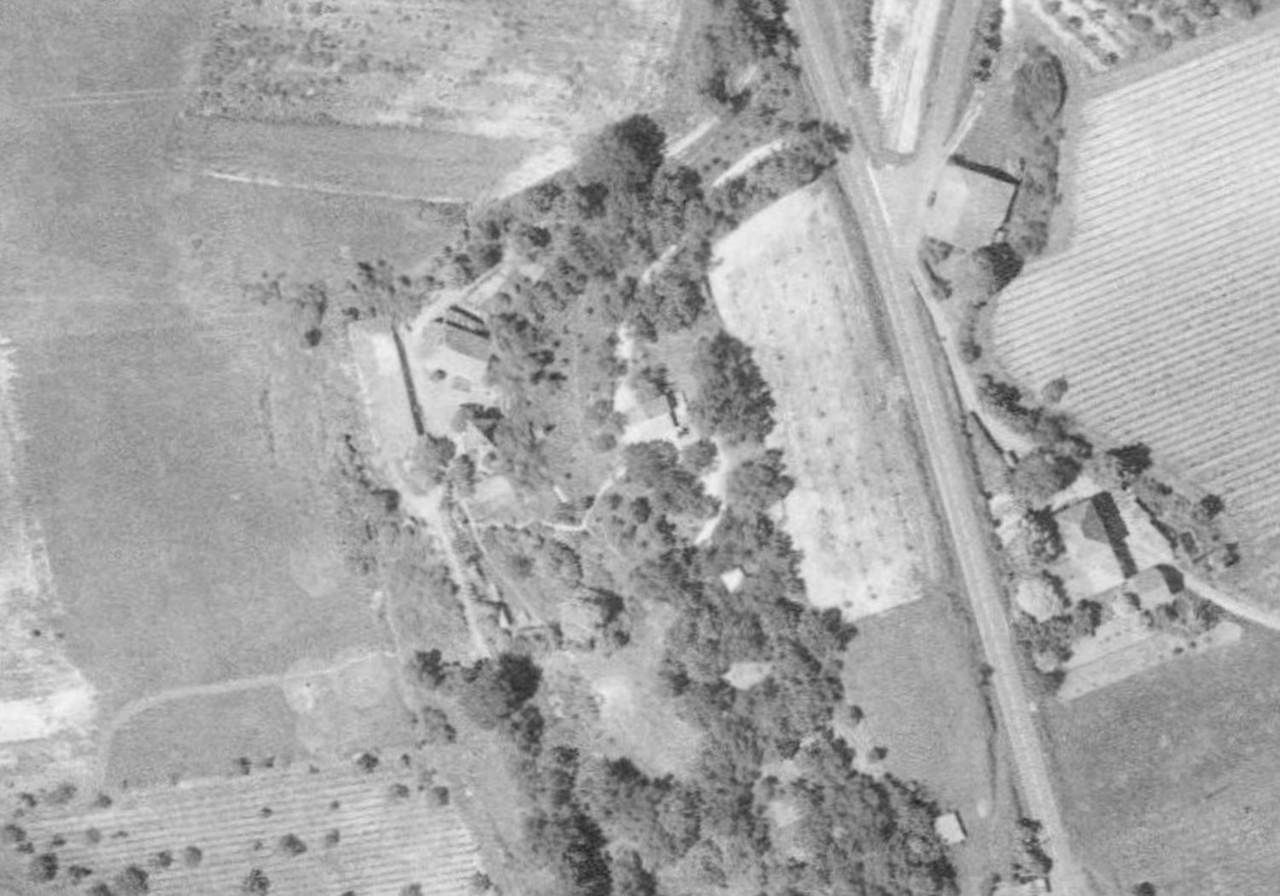
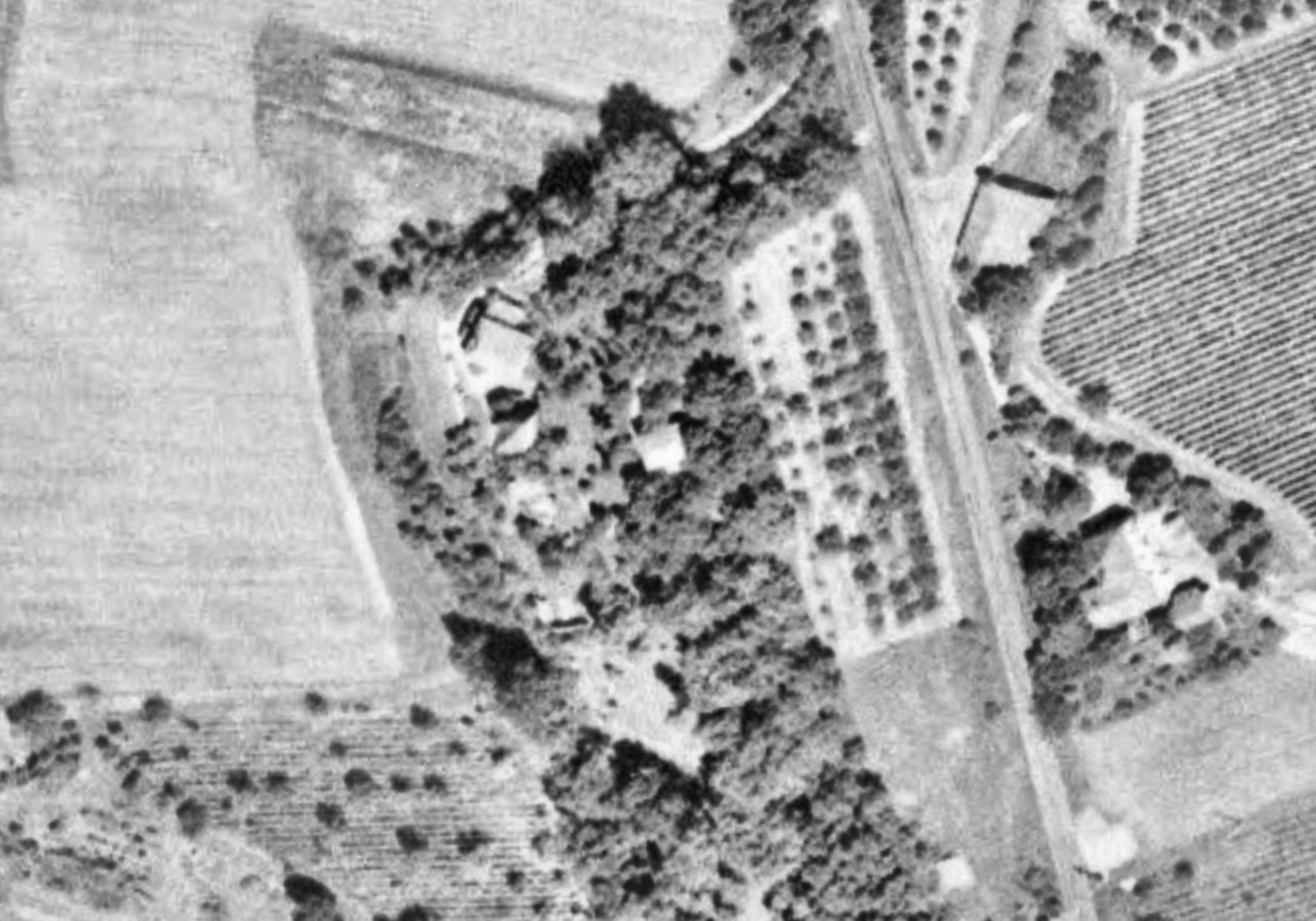
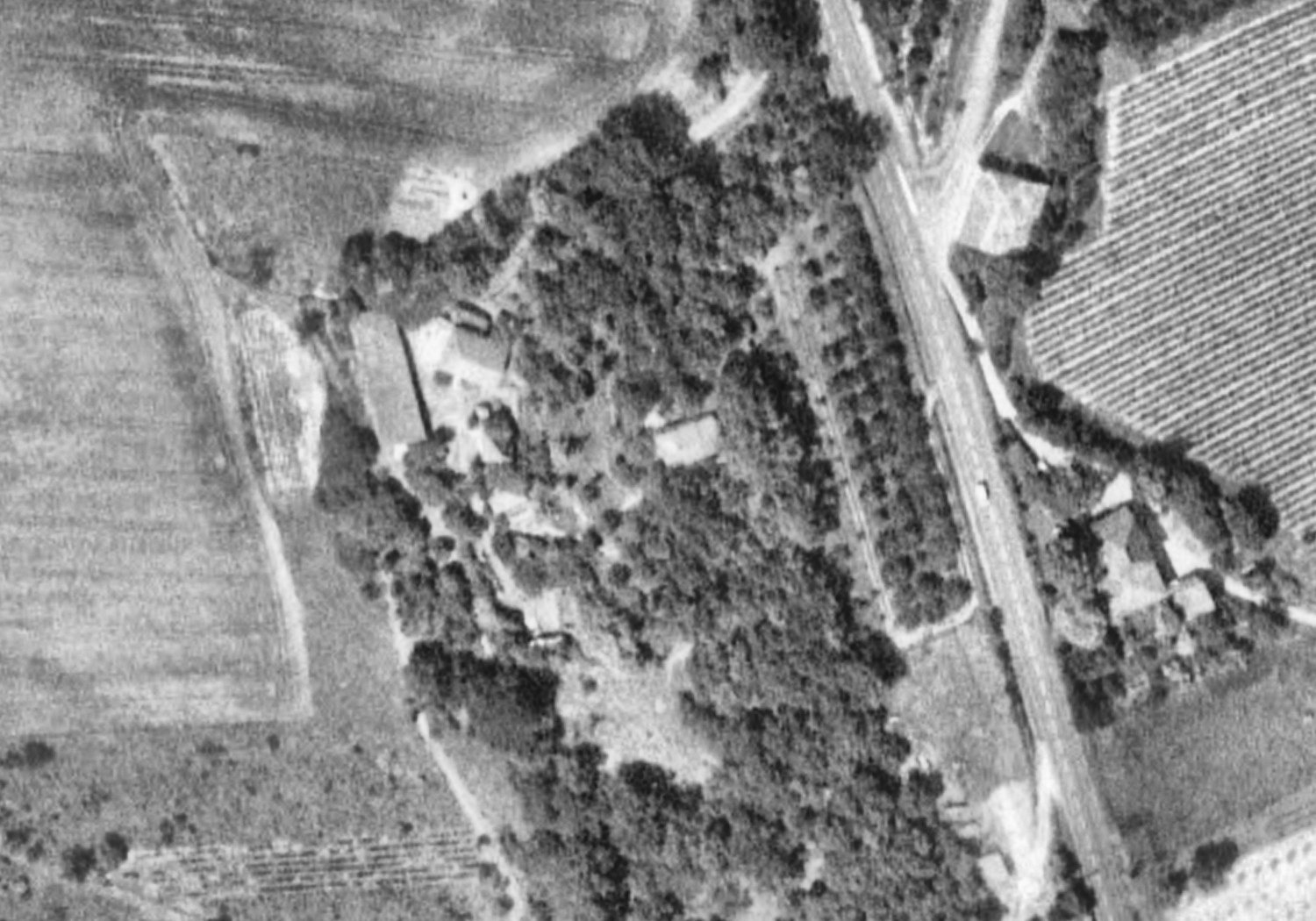
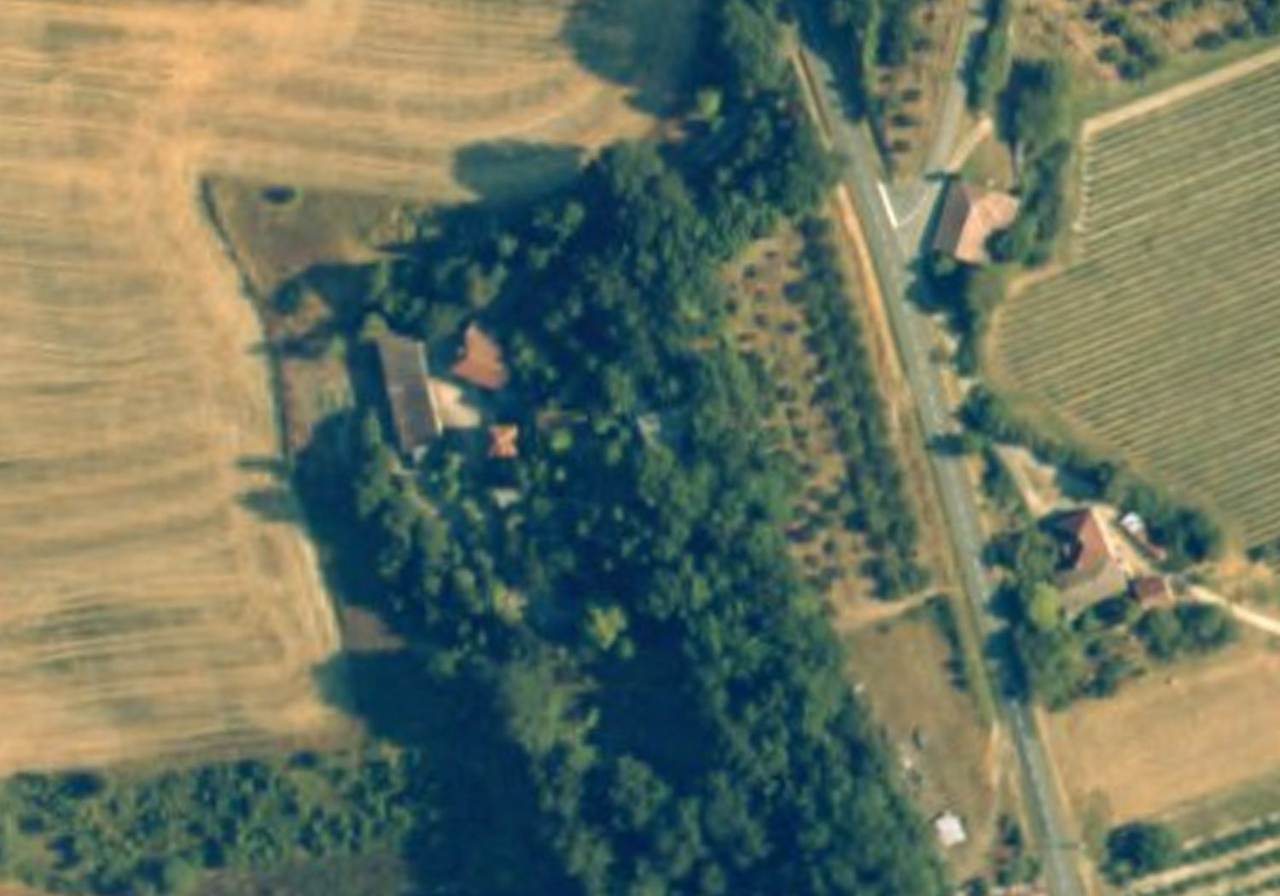
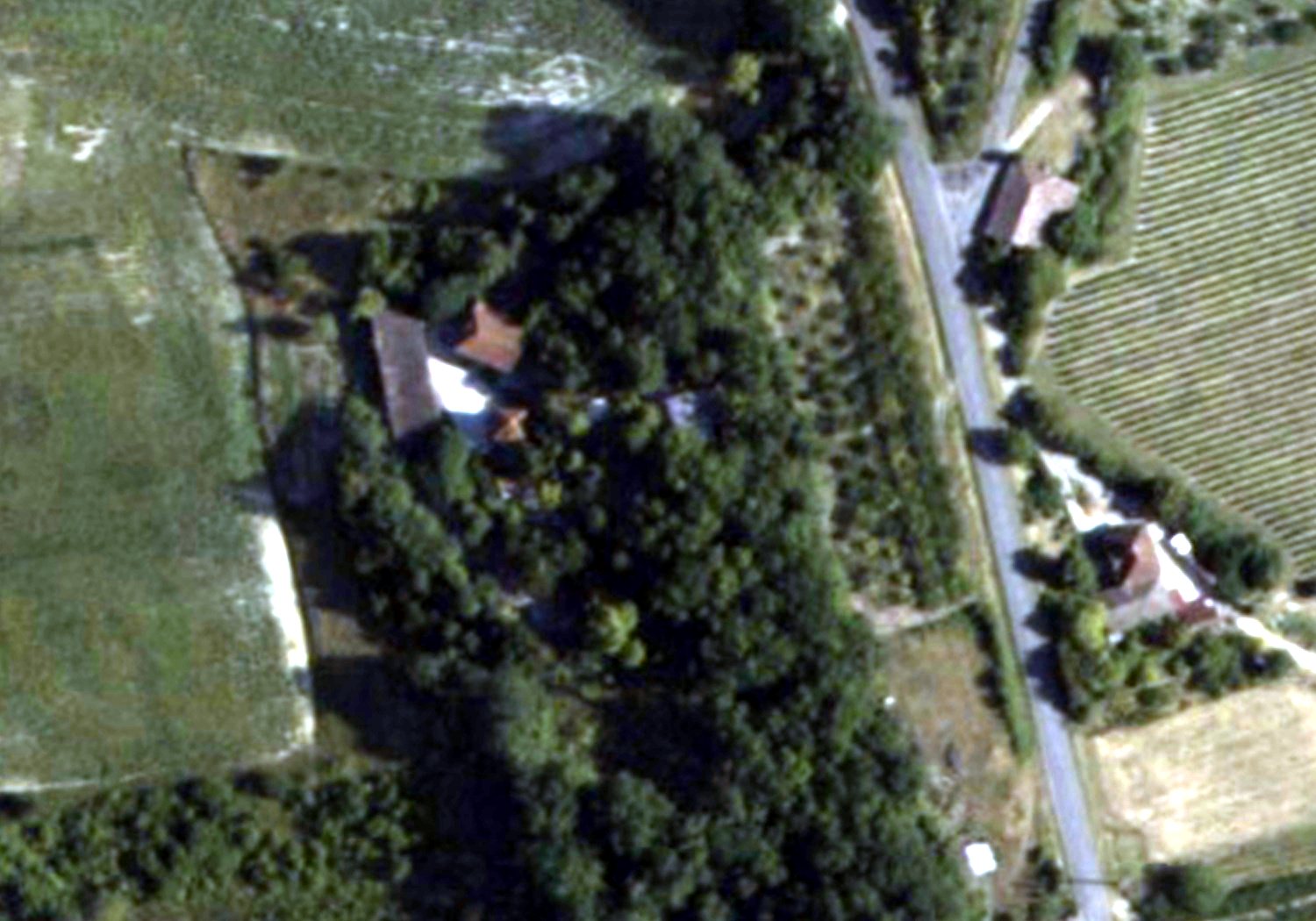
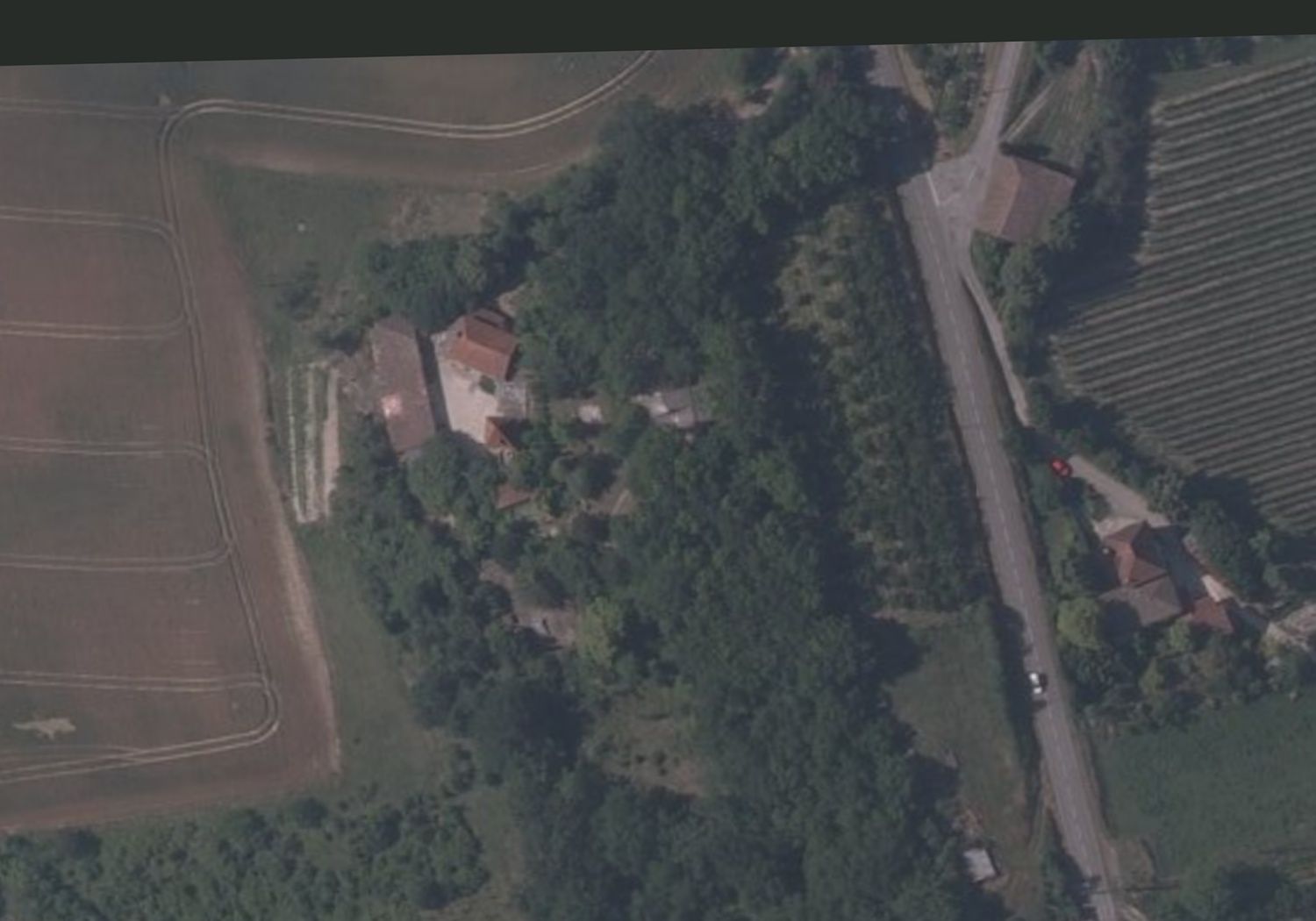
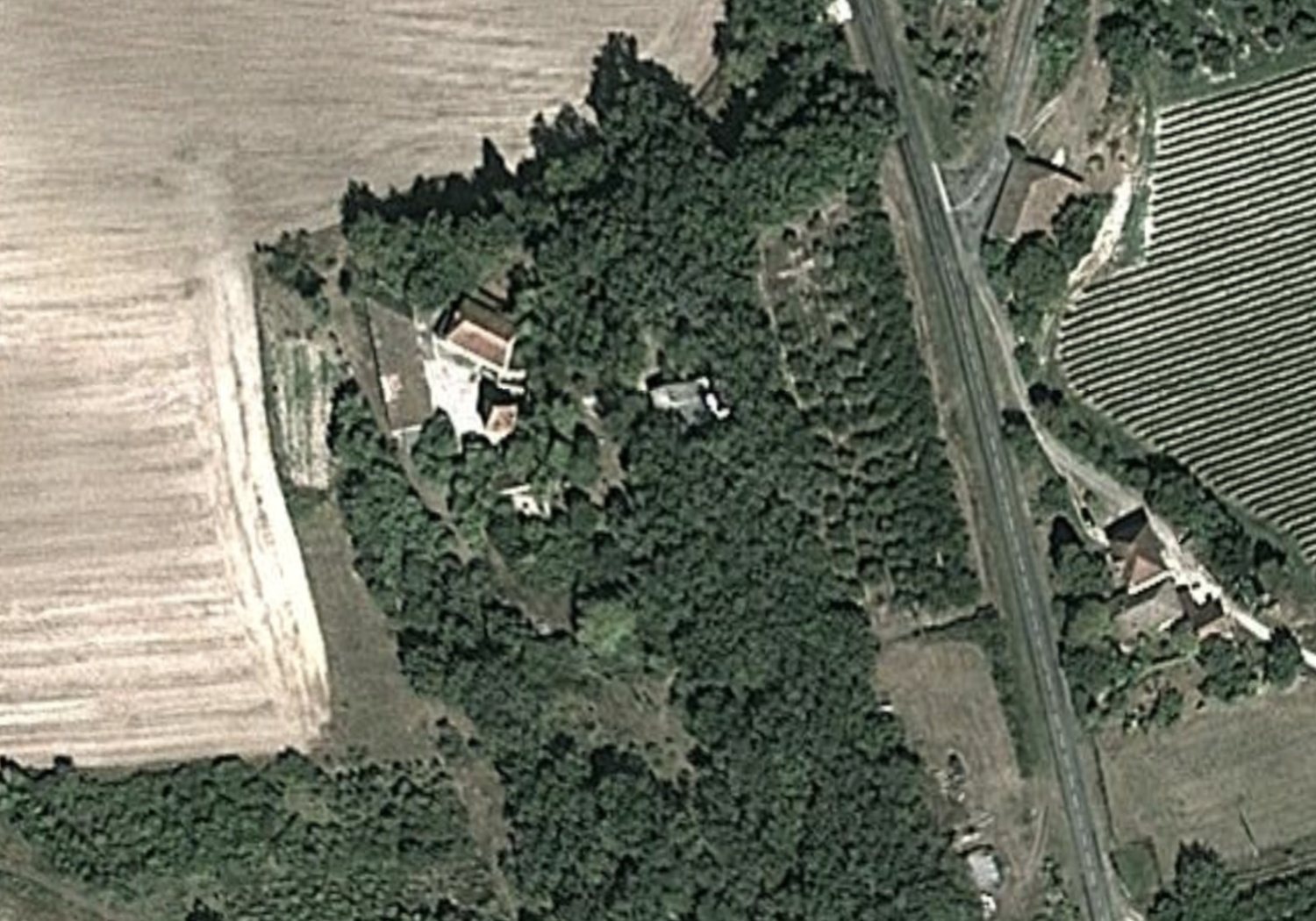
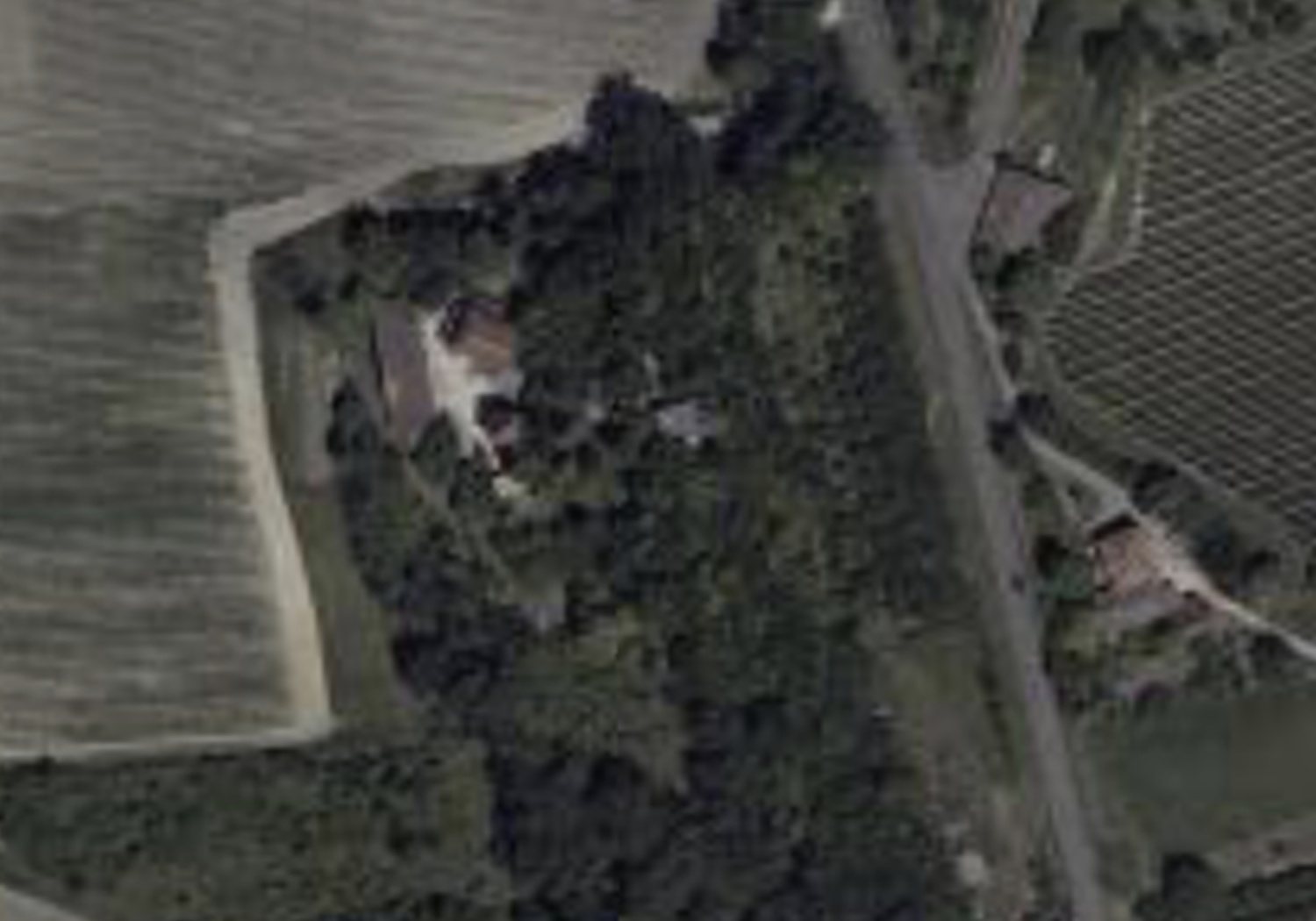
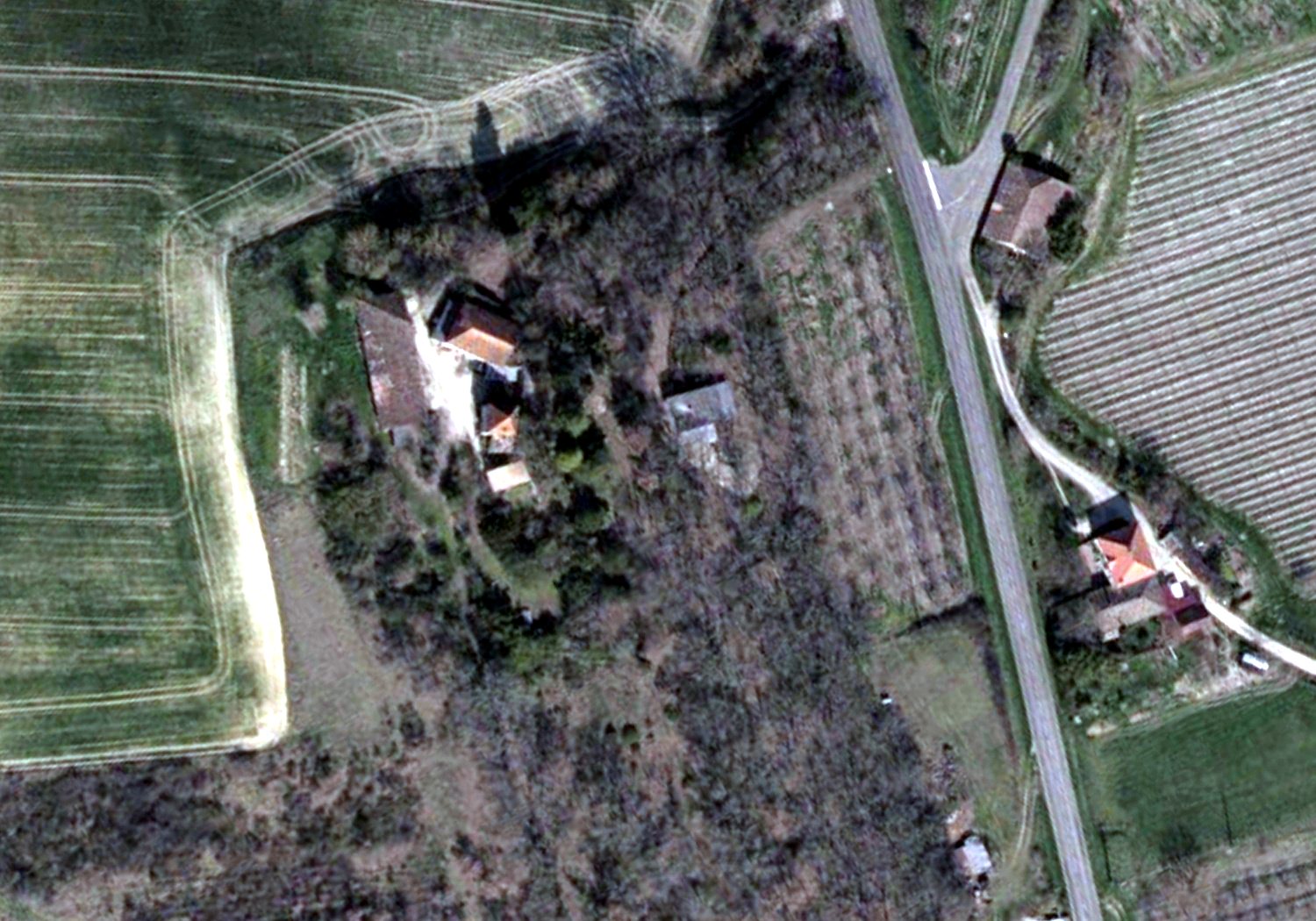
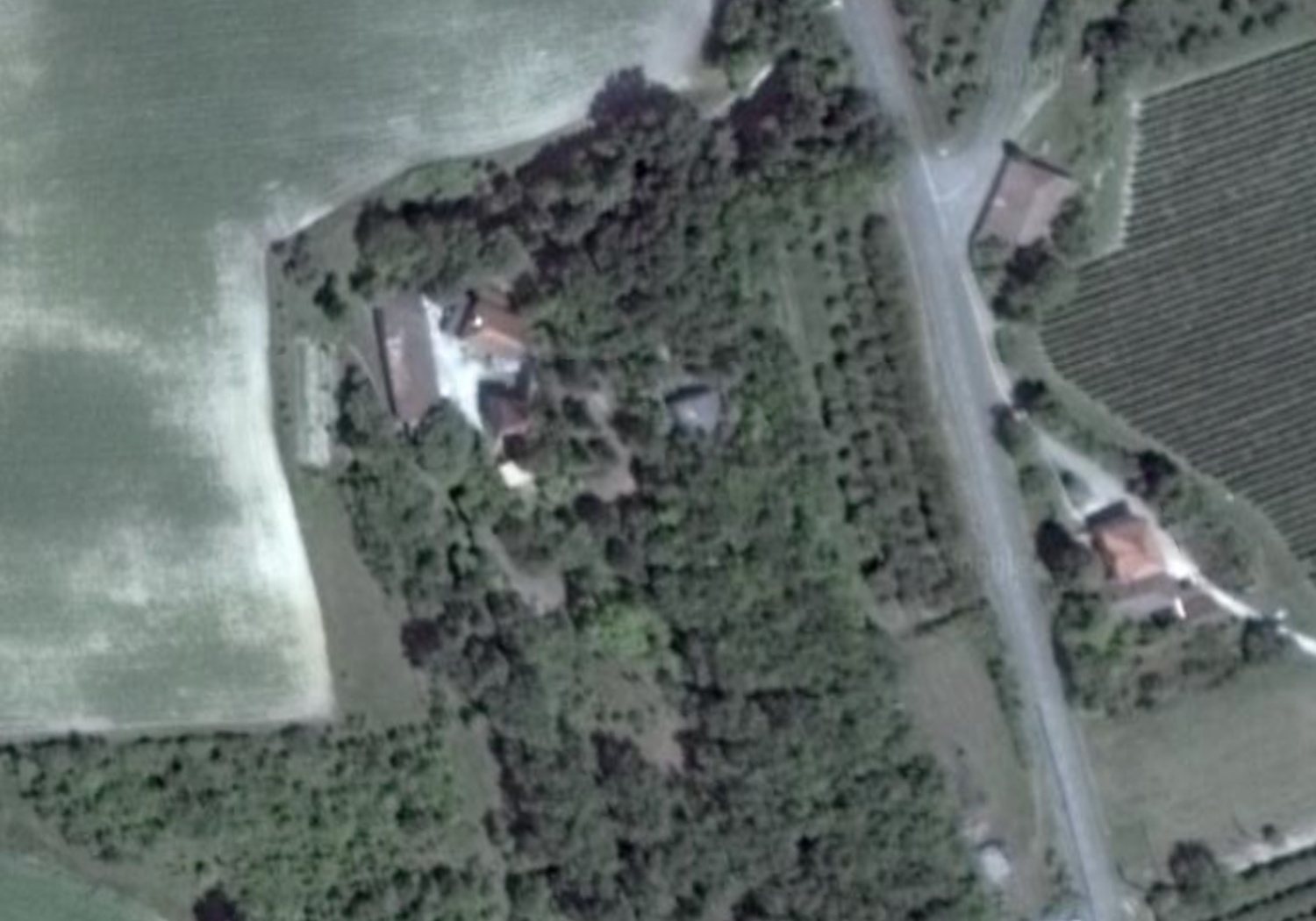
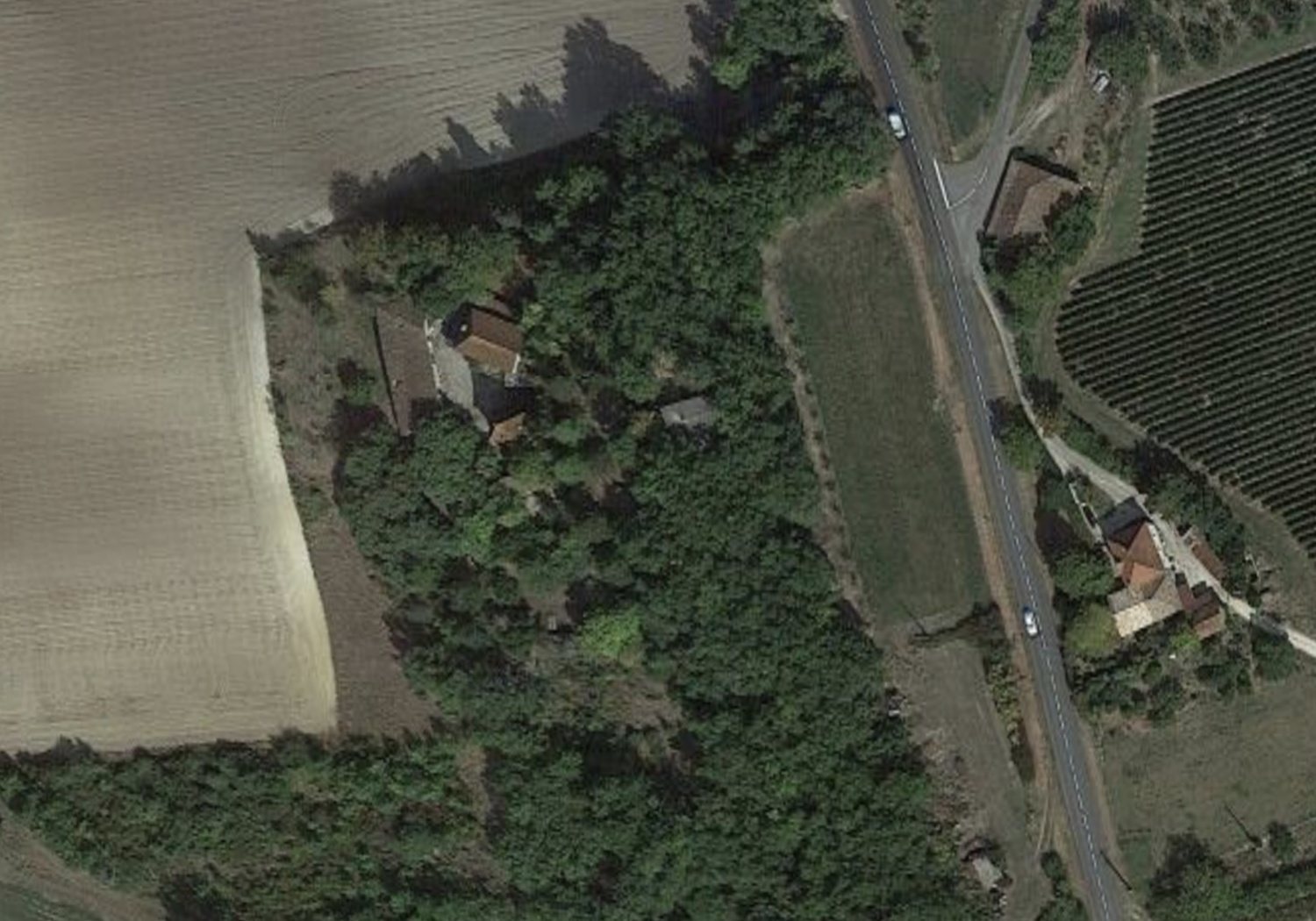
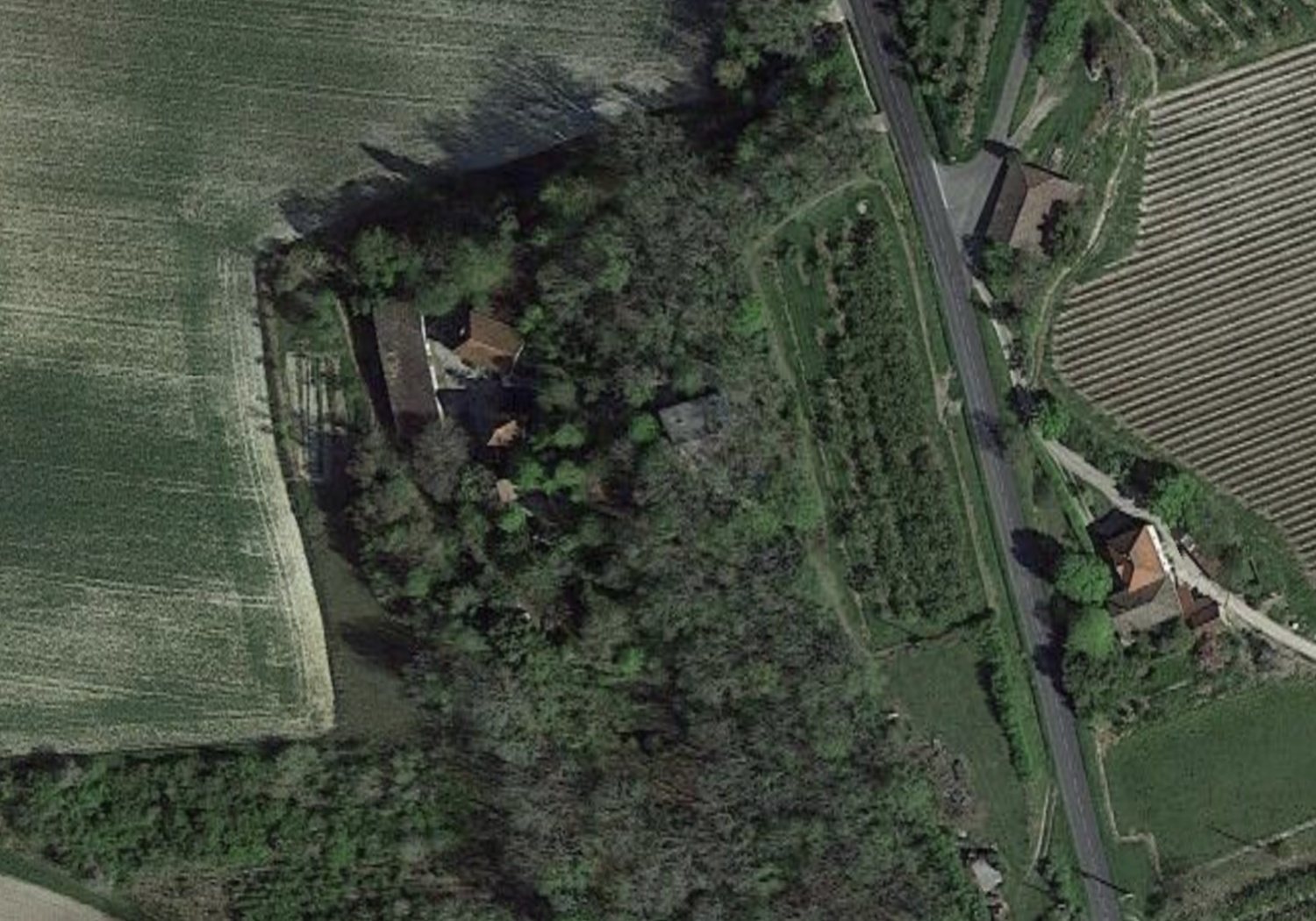
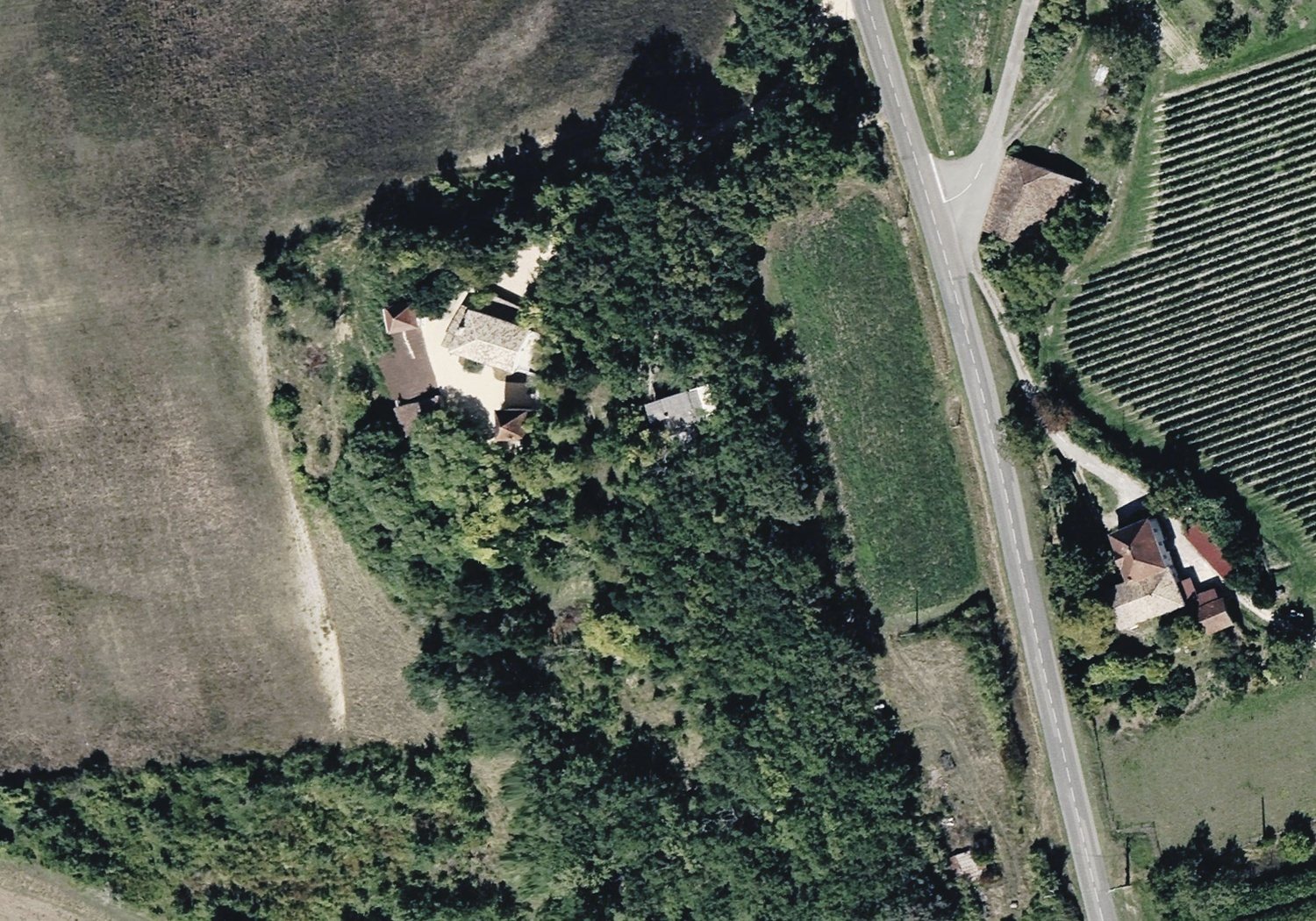
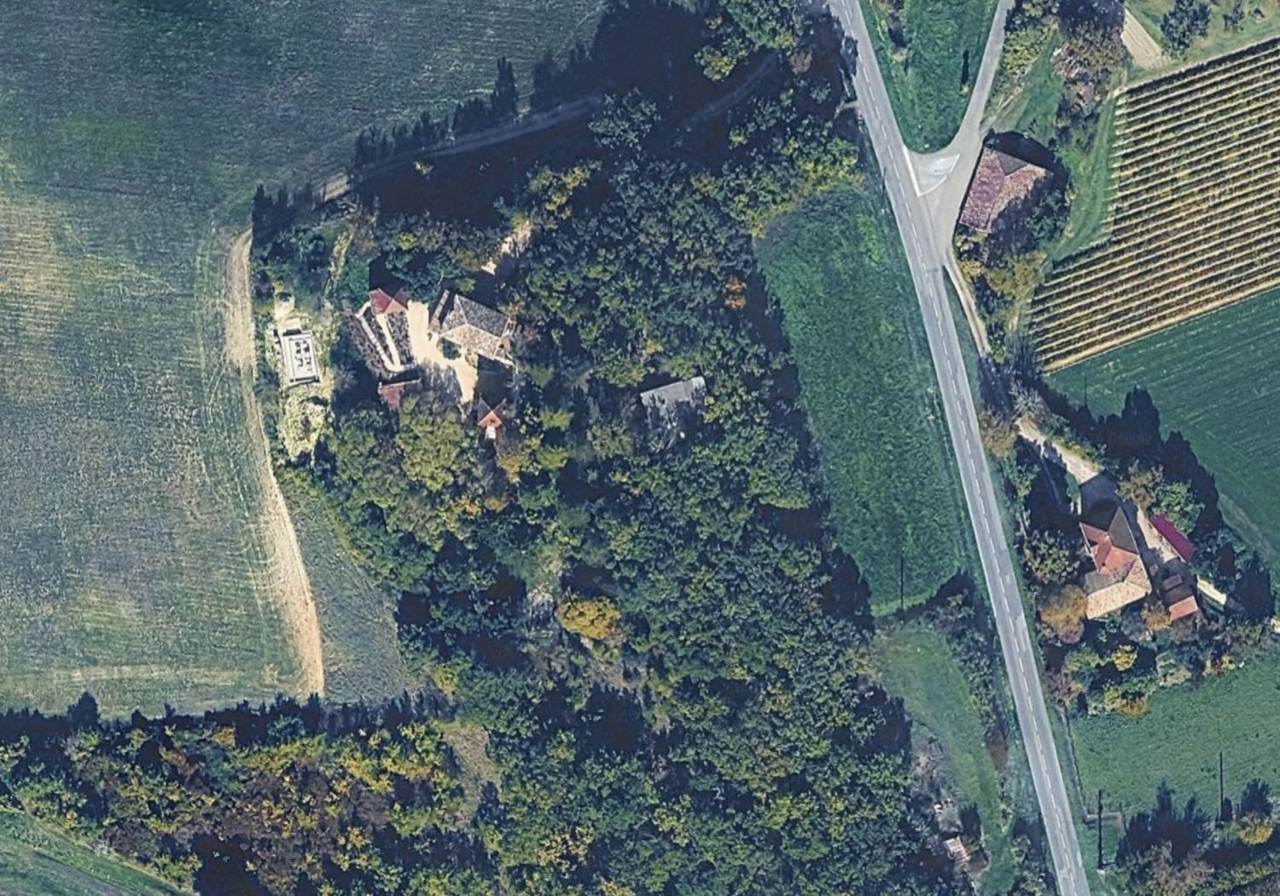
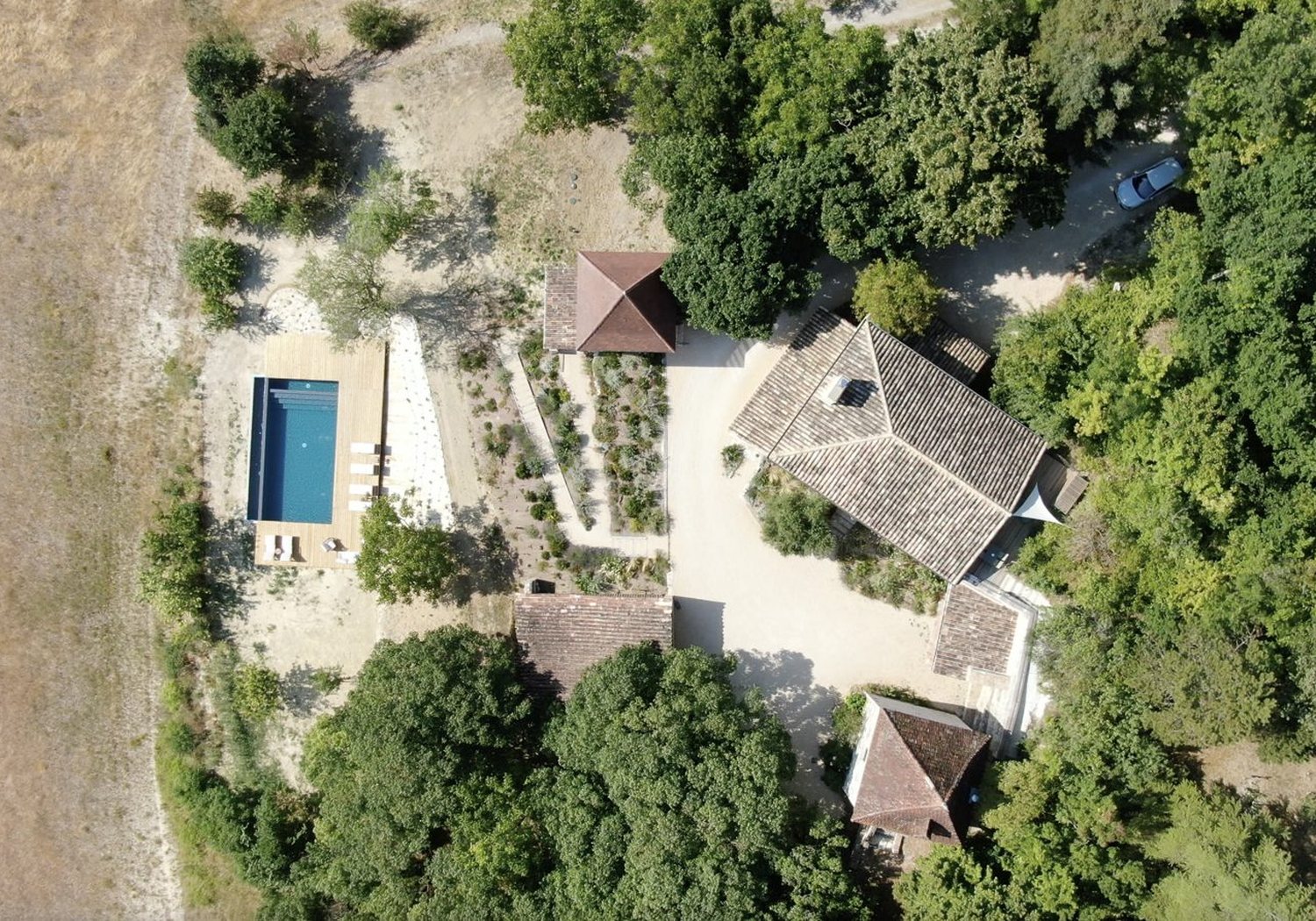
© IGN, Remonter le temps (1948–2014) · Google Earth (2012–2025) · Apple (2024) · drone (2026). Framing aligned on the farm.
The farm’s last years
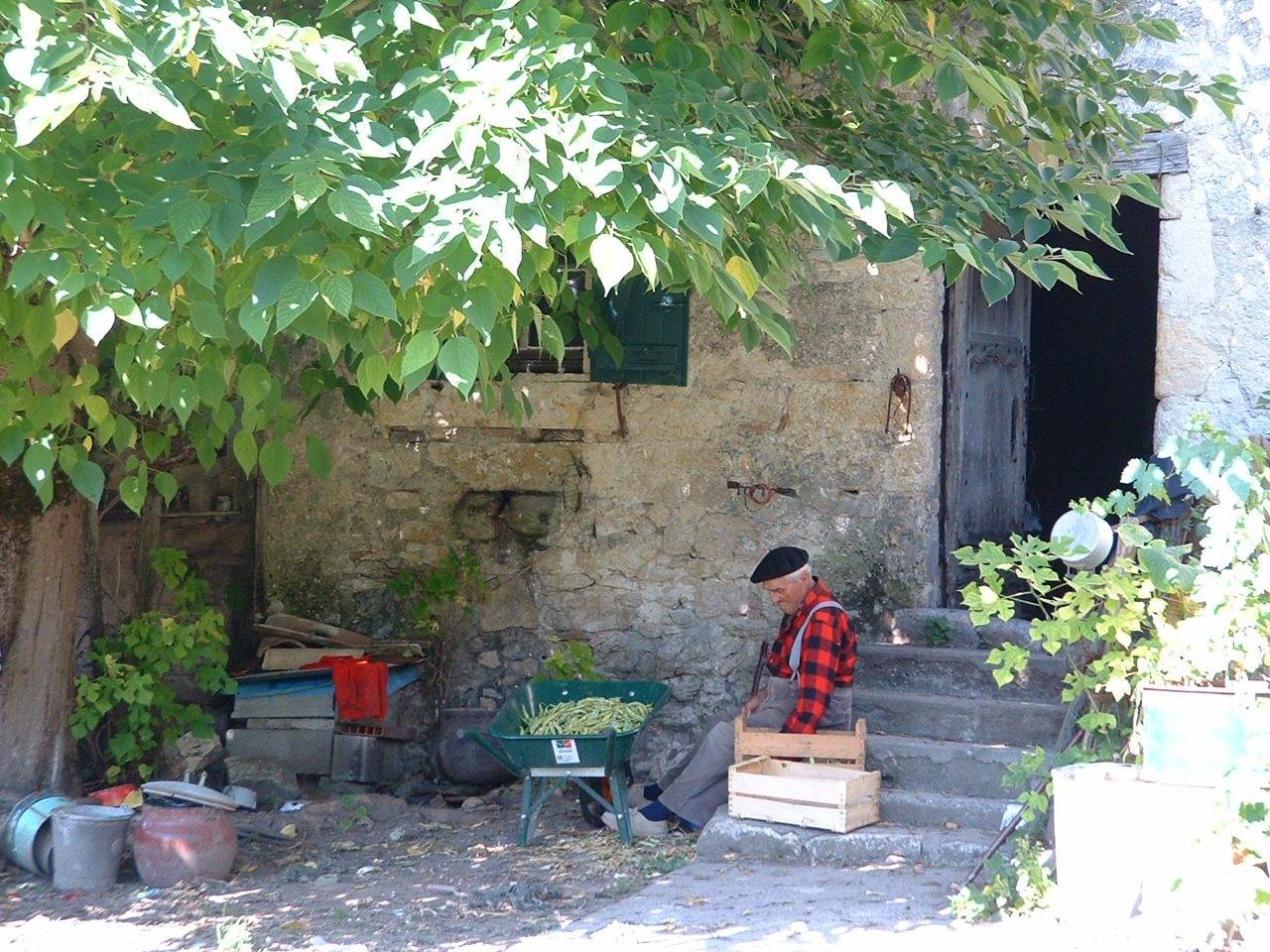
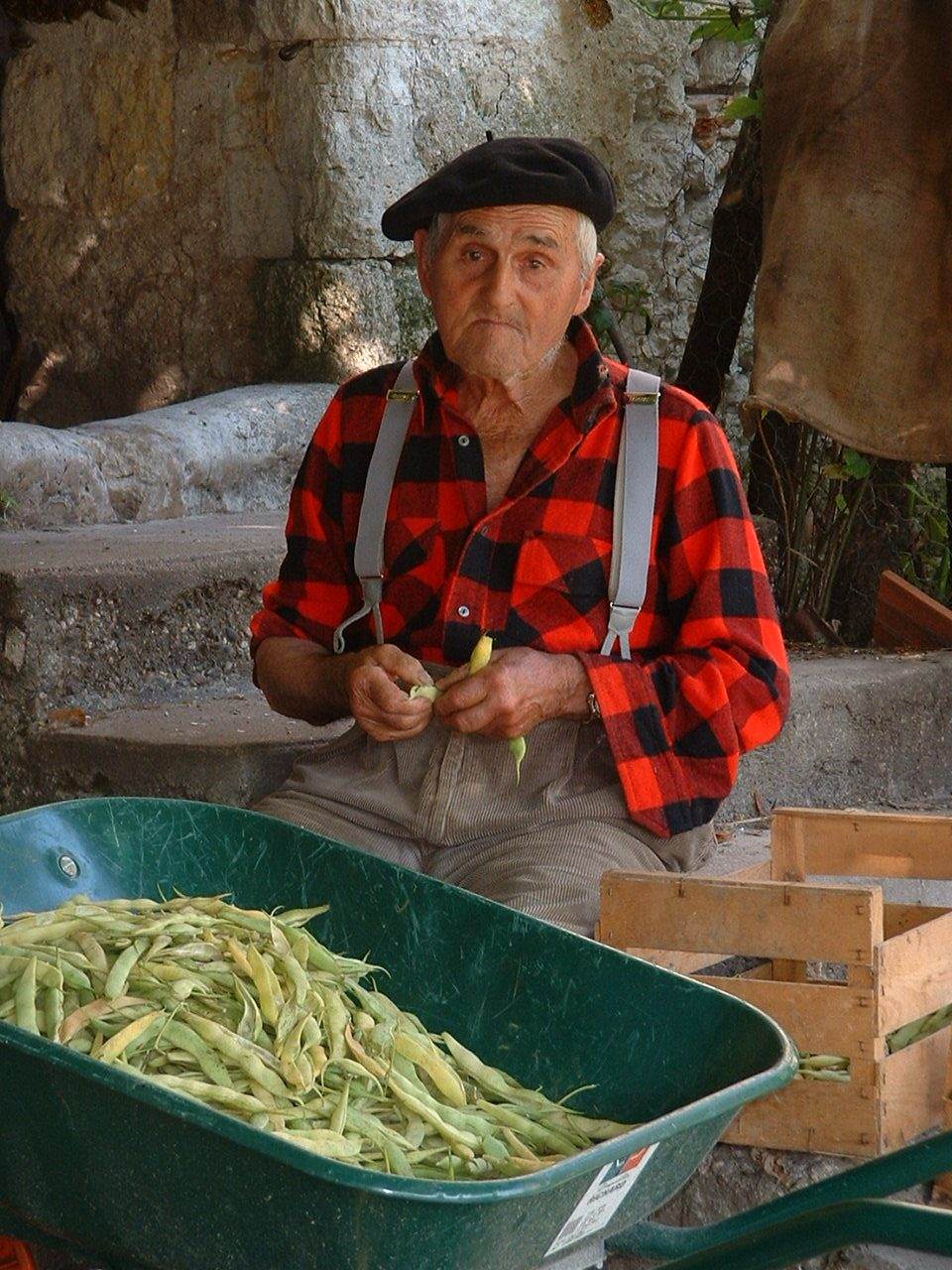
The Salevieilles family lived at Tayssou for most of the 20th century. The last of them were a brother and sister: Lucie (3 July 1908 – 5 September 1993) and René (21 February 1914 – 21 November 2004), born and died in Lauzerte. In the 1980s–1990s photographer Robert Pardo captured the dovecote, its eaves and its flight dormer. In 2002 René was still shelling beans by the stone steps. On his death he left the property to the child hidden there during the war.
To the whole neighbourhood, René is “la Granisse”. His door is always open: every day people stop at Tayssou for a drink or a meal. Life there is spartan, but never short of good humour. René walks to Lauzerte; the farm has no running water or electricity until the end of the 20th century, and he digs the wells himself. He works with his cows and the same tools as in the 19th century. In the main room a big pot stays on the fire, and the walls are black with smoke and soot.
The portraits vanish
Meanwhile in Lauzerte, the hospice had become a retirement home and then a care home. When it moved to its new building, the two portraits of Fleur and Pierre were auctioned in Versailles, then sold on to a foreign art dealer. It is a loss for Lauzerte’s heritage. The Amis de Lauzerte, the local heritage society, quickly launch an appeal to find the paintings; Pierre’s is still missing to this day.
The first visit
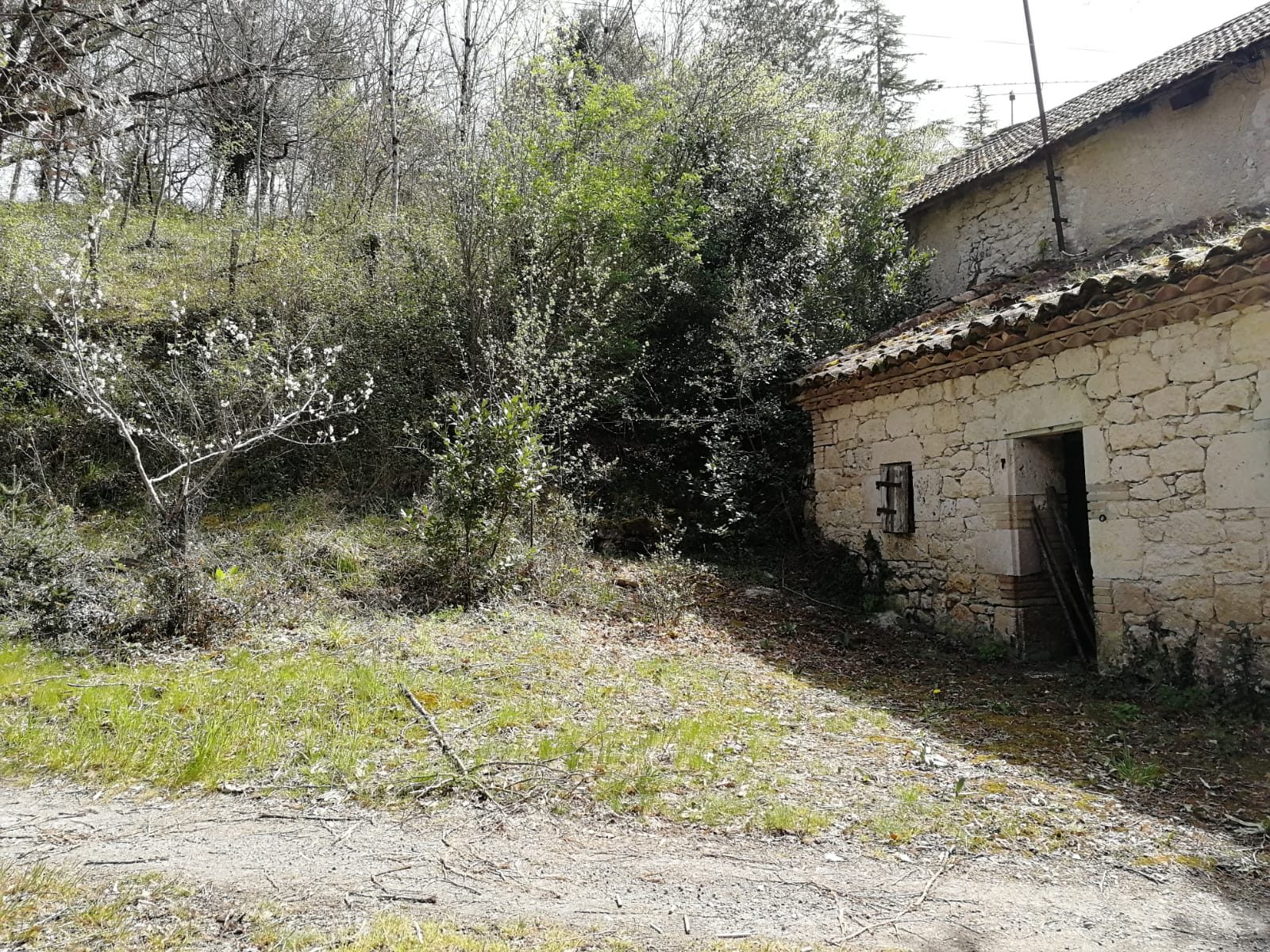
The listing appeared in March 2020, in full lockdown. In early July, between two lockdowns, we saw Tayssou for the first time. The farm was in ruins, but the view of Lauzerte, the strength of the buildings and the evening light did the rest: within a few hours we had decided and committed.
The purchase — and the investigation
A year after the listing, the farm becomes Manon and Maxime’s in March 2021. A year earlier, Lauzerte’s revised local plan had listed it as a group of buildings to be preserved. Research begins at once in the archives of Montauban and Toulouse. In December 2021 the Amis de Lauzerte publish an appeal to find the portraits; in 2022 a plaque is unveiled in the “Fleur de Darnal” room of the care home.
Preparing the works
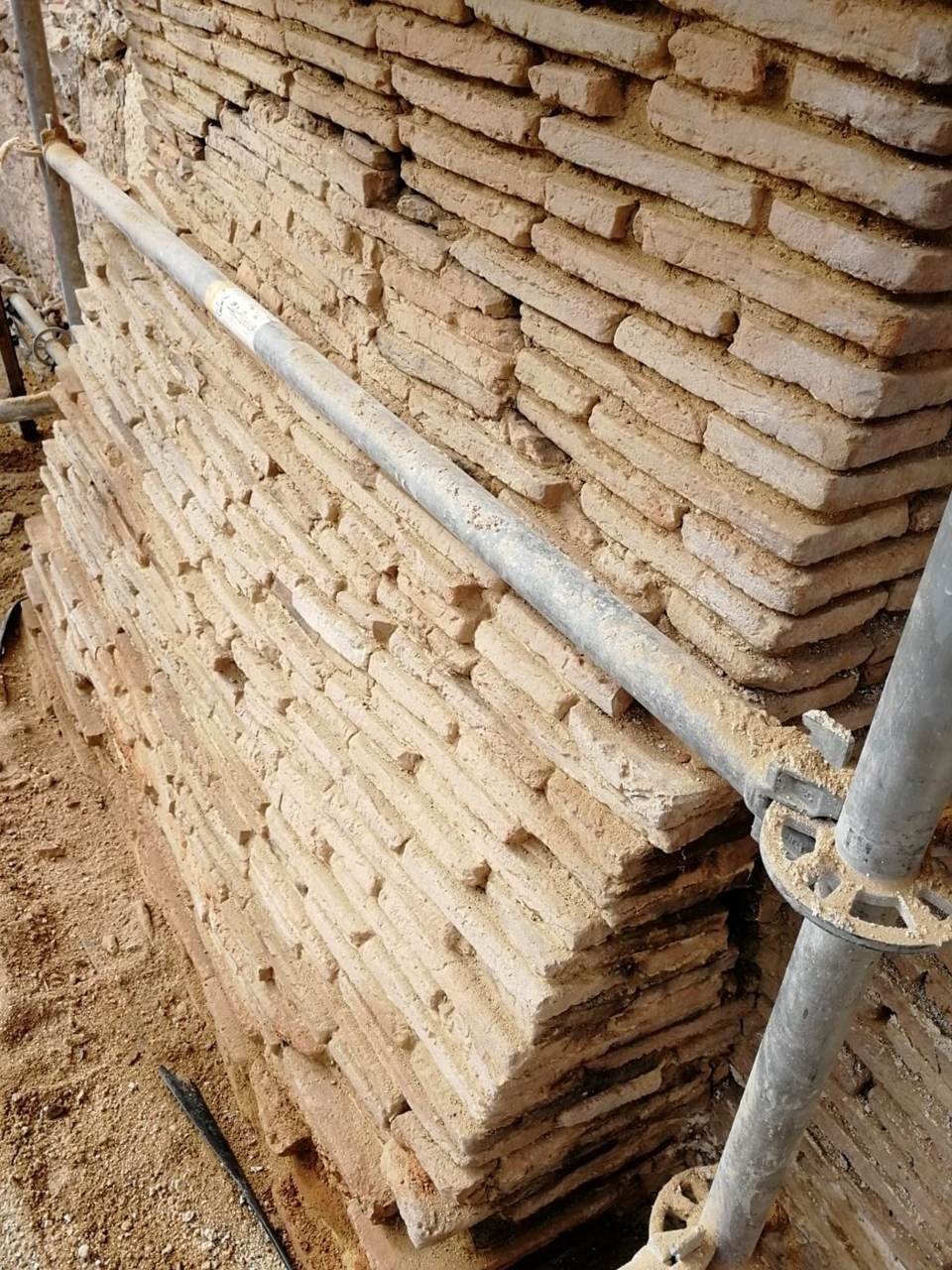
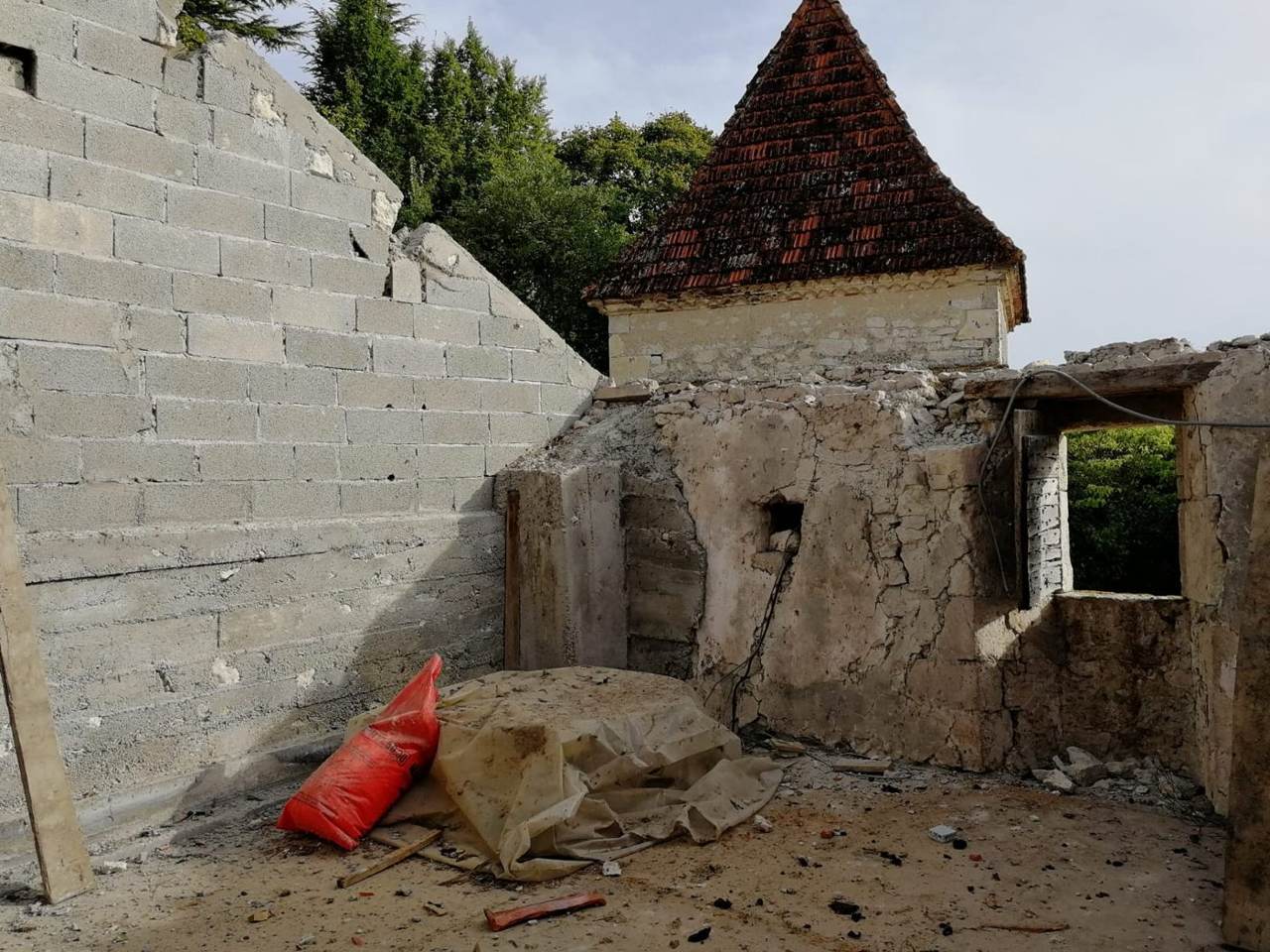
Six months to get ready: quotes and meetings with local craftsmen, soil survey, measured drawings, heritage report, choice of materials, planning permissions and the first grant application. On site, a century’s accumulation had to be sorted, from household belongings to old farm machinery and tools; every canal tile that could be saved was salvaged one by one, and the utility networks were buried. Meanwhile, research in the Montauban and Toulouse archives brought Fleur de Darnal and the story of Haut-Castel back to light.
The restoration adventure, 2021–2026
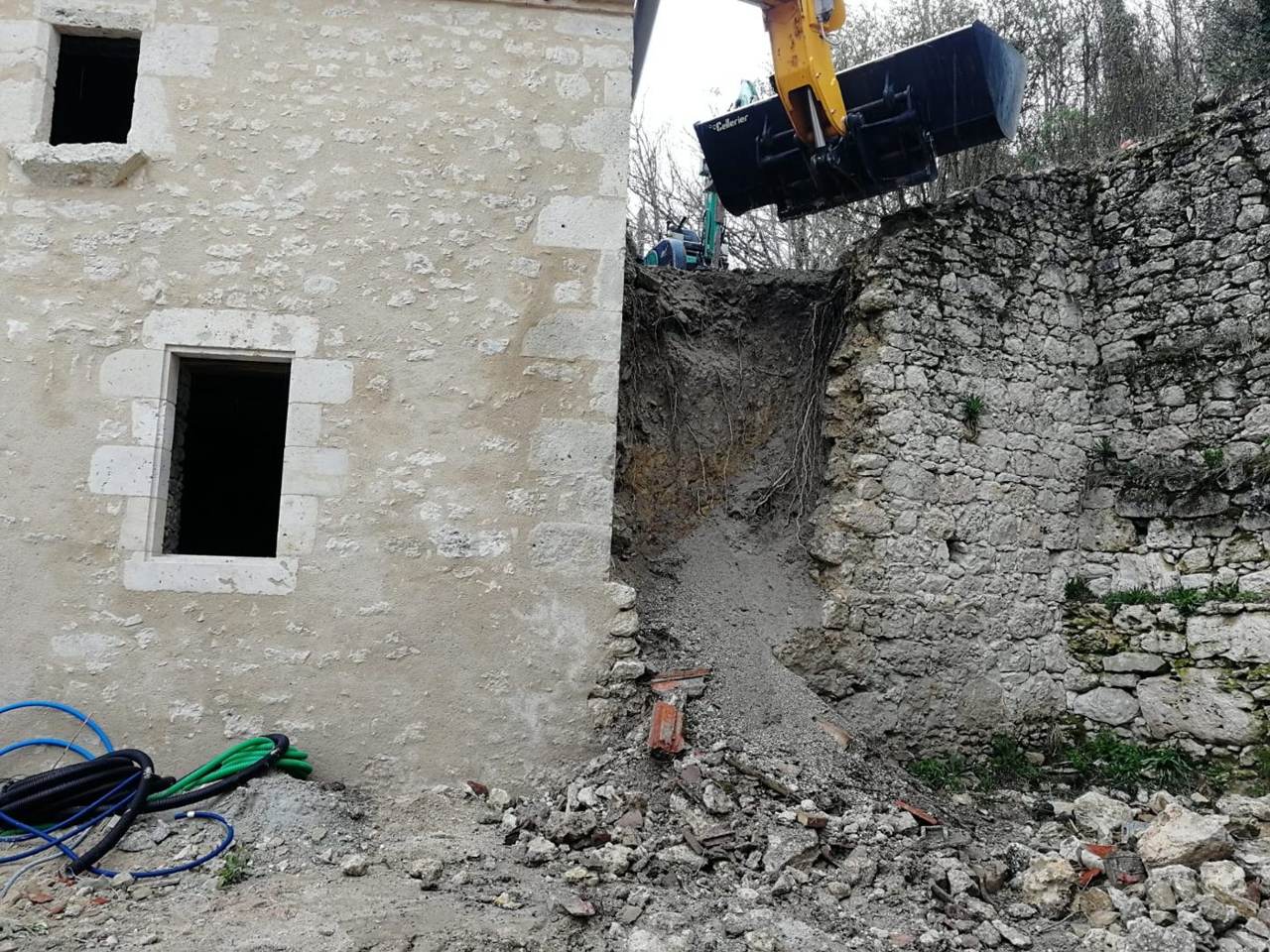
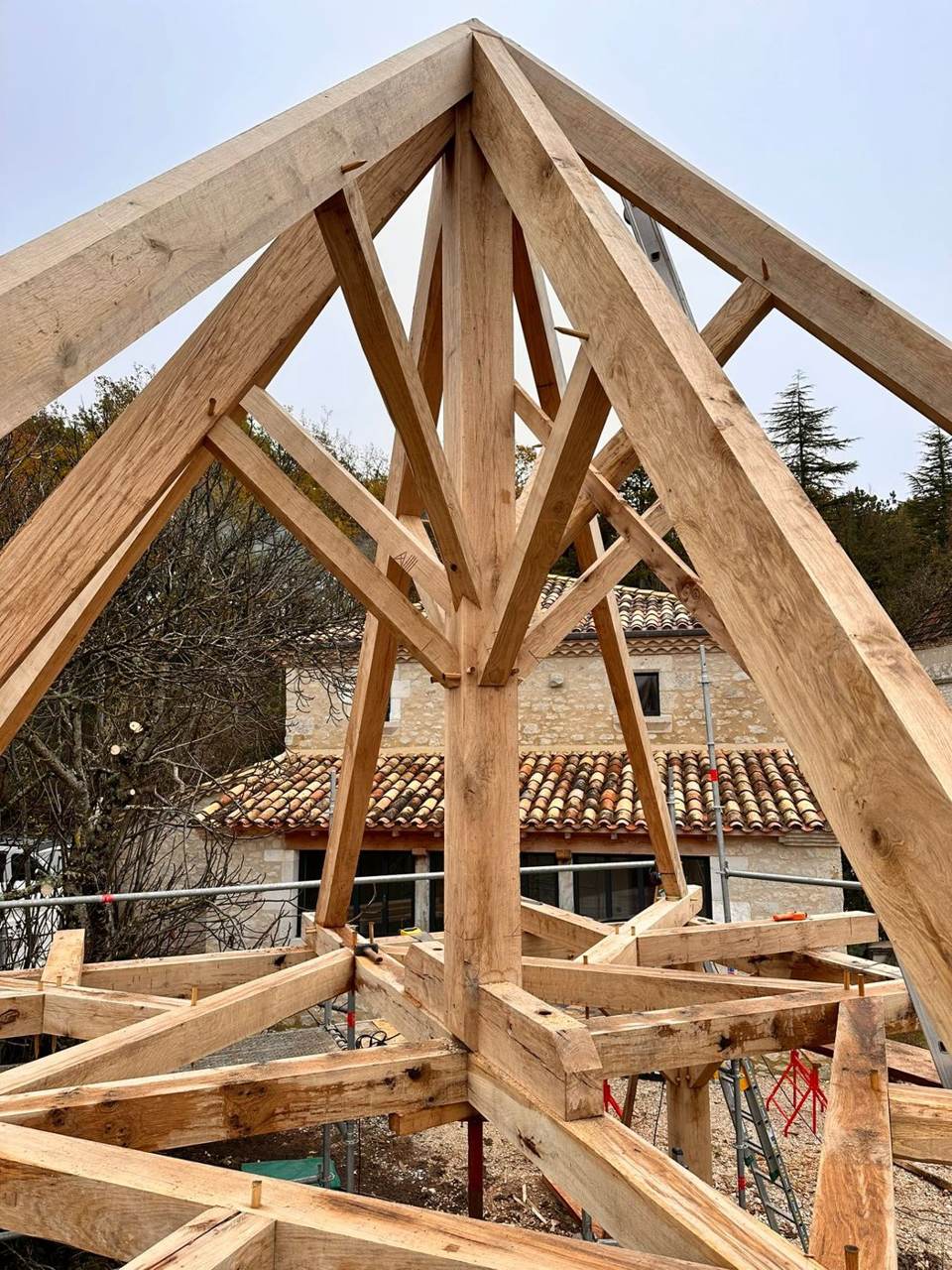
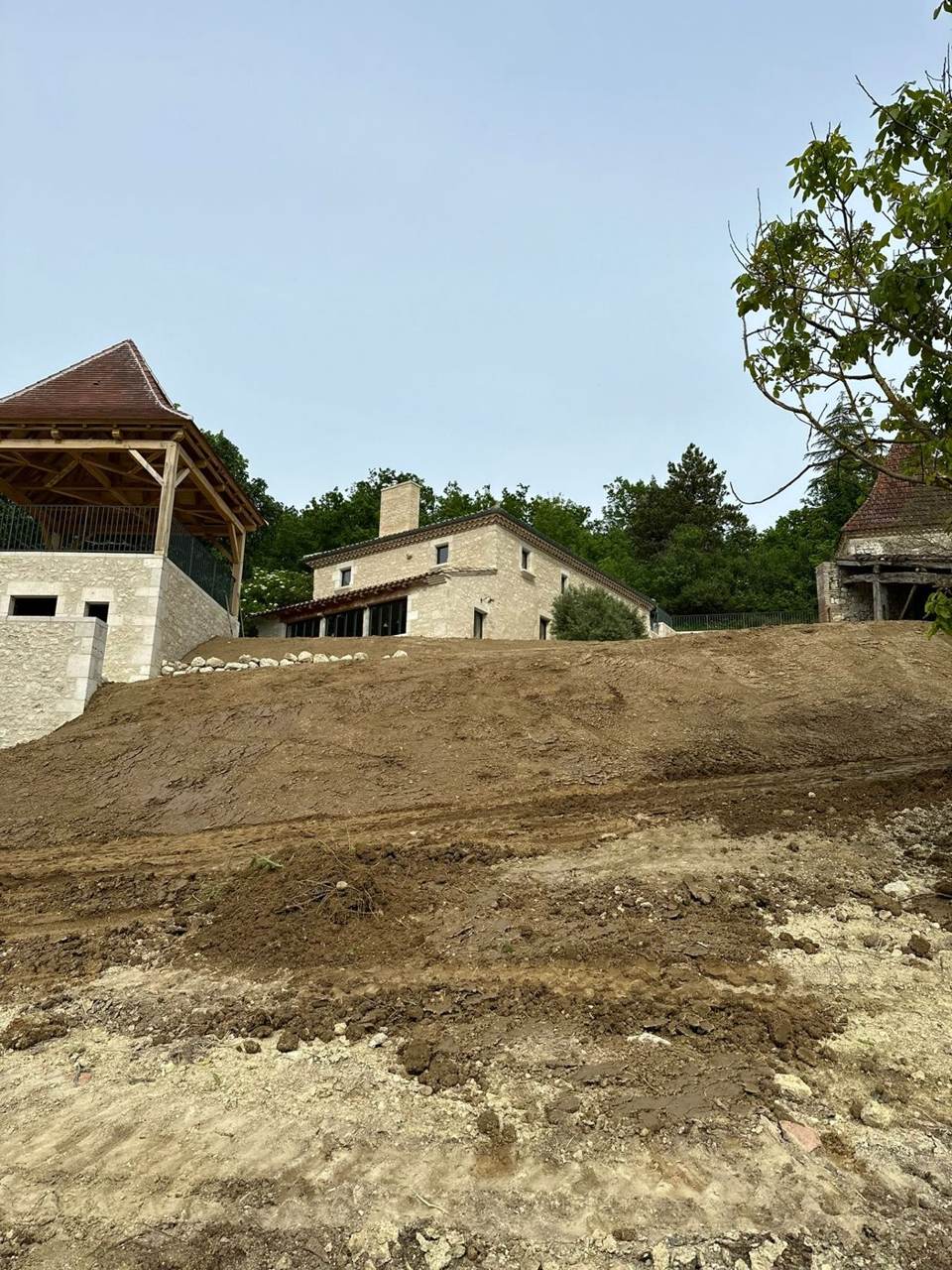
From late 2021 to 2025, with the support of the Occitanie Region and the European Union (LEADER programme), the ruined farm was taken back from top to bottom:
- cleaning, sandblasting old floorboards, reclaimed beams and timber;
- new roofs and timber frames, new eaves, reclaimed tiles;
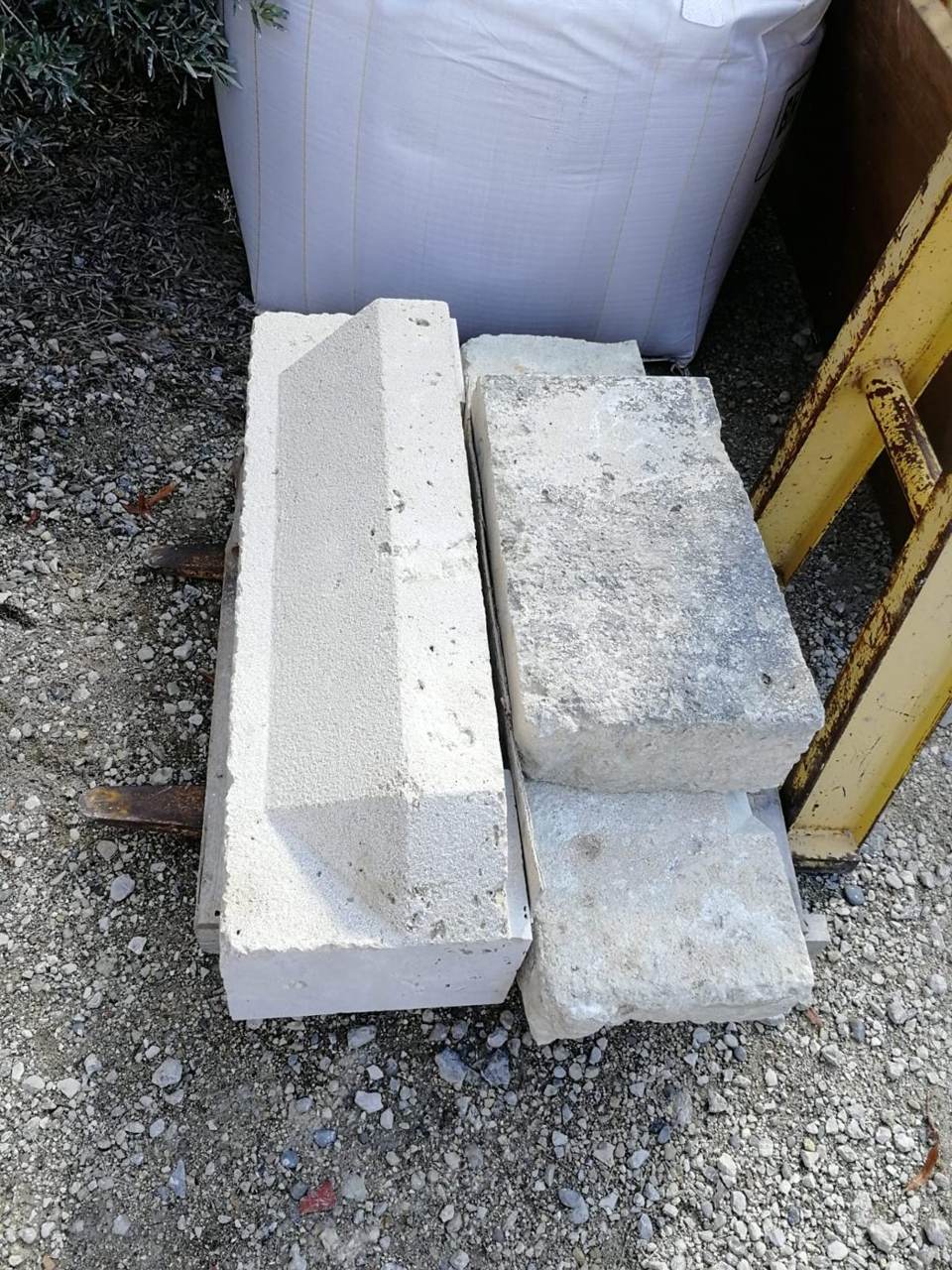
- stone from part of the barn reused, barn–gazebo corner rebuilt, frost-damaged stones repaired;
- dovecote steps and the collapsed retaining wall rebuilt;
- floors and walls taken back, lime and lime-hemp renders, new openings, oak joinery;
- heating, air conditioning, electrics, utilities and drainage, access;
- decoration, terraces, landscaping and native planting (oaks, maples…), then the pool.
Our choice of materials: only noble, local materials, limestone, lime, lime-hemp, terracotta, oak, steel, and very little cement, only where it was essential.
The aim: change the use without erasing the reading of volumes, masonry and timber. The craftsmen behind the work are presented on the estate page.
Five years of work, from summer 2021 to 2026, told in photos and a timeline.
Fleur comes home to Lauzerte
In late 2023, after months of searching between New York, London, Versailles and Gloucester, we traced Fleur’s portrait to a private collector in Wales. Through the gallery that had sold it, we wrote to him and made an offer, which was accepted. On 19 February 2024 the painting returned to Lauzerte in perfect condition. Pierre’s portrait is thought to have gone to Canada: we are still looking for it.
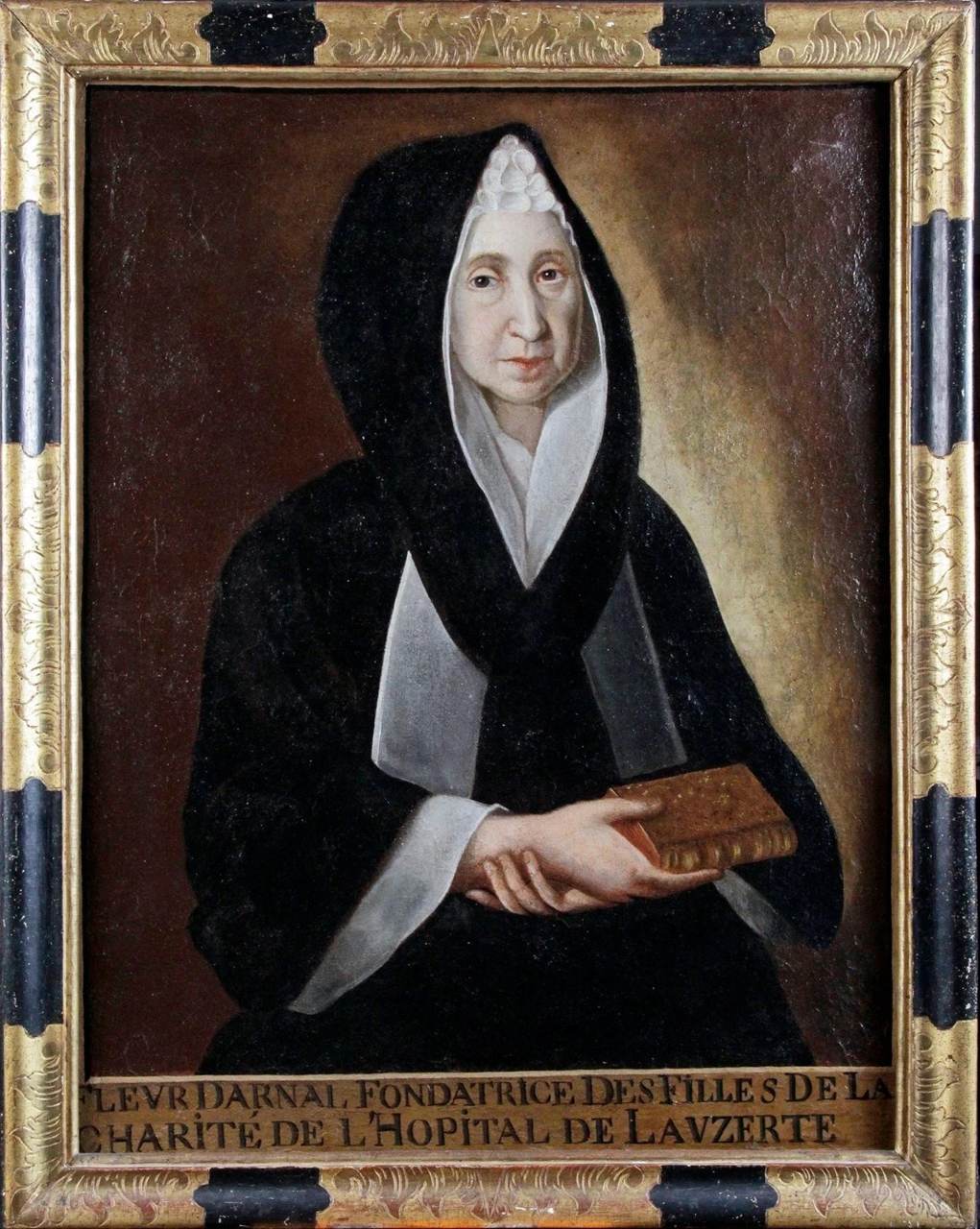
Portrait of Fleur de Darnal
Oil on canvas, French school, c. 1700. 81 × 61 cm in its moulded, painted and gilded frame. Restored in the 20th century.
“Fleur Darnal, founder of the Daughters of Charity of the hospital of Lauzerte”
Dressed in black, with a white headdress and a book in hand: the image of a devout, learned woman who gave her fortune to the sick. If you know where her brother’s portrait is, write to us.
Domaine de Tayssou opens
The farm takes the name of its hamlet and welcomes its first guests. It is classified as 5-star furnished tourist accommodation and awarded 5 épis by Gîtes de France.
France’s most beautiful gîte
In Nantes, the jury of the 14th Coup de Cœur Awards of the national Gîtes de France federation names Tayssou the most beautiful rural gîte in France, out of 67 entries, a first for Tarn-et-Garonne. The infinity pool opens the same year; a Nordic hot tub and the restoration of the outbuildings are the next chapters.
The story continues here
Three centuries after Fleur, the farm is full of life again. For lovers of history and heritage it is a stay apart: sleeping within 15th-century walls, finding Fleur’s portrait in the library, walking the Way of St James, then exploring the Moissac cloister, the bastides and the Most Beautiful Villages of the Quercy. We are happy to tell you the story of our research, archives in hand. Every stay adds a page to Tayssou’s story: the next one might be yours.
Plan your staySources
- Archives of Tarn-et-Garonne: Lauzerte parish registers (3 E 094-3); deed of gift of 8 September 1711 (5 E 5725); Napoleonic land register; deed of sale Lauzerte hospice – Salevieilles (October 1908) and prefectoral order of 7 April 1908.
- Archives of Haute-Garonne: Darnal – de La Bonne marriage contract (1649); records of the Entraide généalogique du Midi toulousain.
- Archives municipales de Toulouse: Annals of the capitouls, BB 280 (1650). Armorial of the capitouls (Gallica, BnF); heraldic reading by Liliane Gaubert.
- Patrice Brassier, “Une noble demoiselle au service des Lauzertins”, Lo Camin, April 2025; transcription of the 1711 deed of gift.
- Jean-Claude Martinez, local historian: research and guidance on the Lauzerte archives and the Darnal family.
- Geneanet, “Familles du 82” database: marriage of Jean-Albert Salevieilles and Marie Marty, Montagudet, 26 February 1908.
- IGN, Remonter le temps: 1948, 1956, 1958, 1967, 1970, 1976, 1977, 1981, 1987, 1994, 2000, 2005, 2009, 2010, 2013 and 2014 missions. Cassini map.
- Google Earth: views from 2012, 2015, 2019, 2021 and 2025; Apple Maps: 2024 view; drone view 2026.
- Photographs: Robert Pardo and the Fournier-Prat family (1980s–1990s); private archives (2002).
- La Dépêche du Midi, 27 August 2024 and 15 June 2026.
- Prat-Fournier and Lafage family archives; Tarn-et-Garonne departmental archives (AD 82); Geneanet genealogical records.
Stay inside the story
Sleep at Haut-Castel
Five centuries of history await you, within these walls of stone and lime.
Book your stay